
Catalyst Watch
Reaction Functions

Welcome to Catalyst Watch at The Transcript, a report for paid subscribers that highlights investment themes from this week’s newsletter.
Kevin Warsh has made it quite clear that he doesn’t want us obsessing over his every word. But the Fed still sets monetary policy, so his words certainly matter to the trajectory of capital markets and therefore to The Transcript. This week’s Catalyst Watch focuses on things we learned from Warsh’s press conference.
1. The Yield Curve May Be Changing
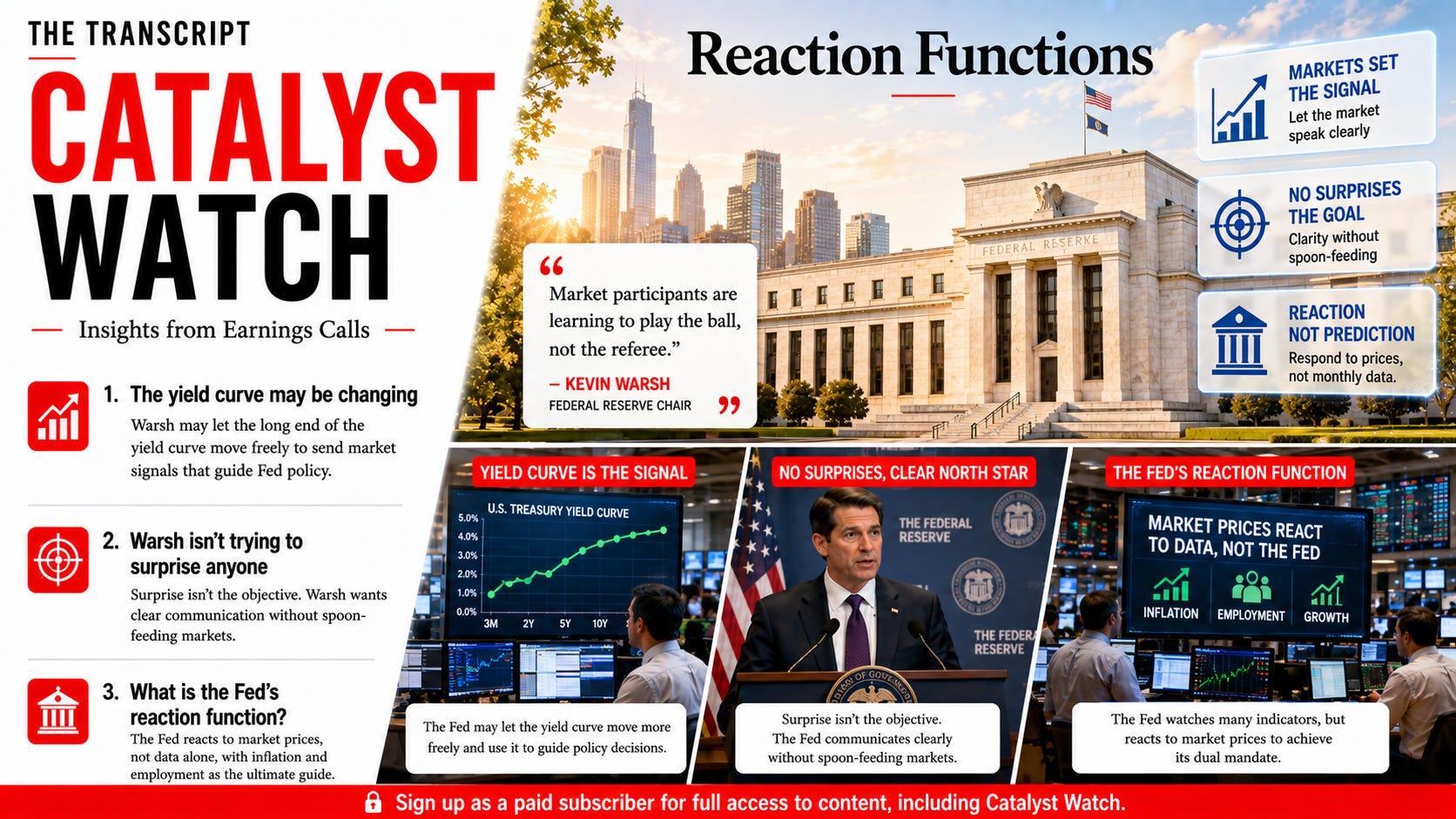
Warsh wants to let capital markets react to economic data rather than focus on the Fed’s policy. He calls this having the markets “play the ball, not the referee.” Here are his thoughts:
“Market participants are learning to play the ball, not the referee—and market prices will continue to respond in the direction and magnitude they see fit. This is, in my view, a change for the better—and we are just getting started...What I’ve really been trying to do...is getting an unfiltered message from markets. Getting a direct message. Letting buyers and sellers meet at prices for Treasuries, for the foreign exchange value of the dollar, and then trying to judge for ourselves, what does that mean about our remit? How are we doing on inflation? How are we doing on employment? We’re trying not to interfere with that market signal.” - Federal Reserve Chairman Kevin Warsh
At face value, Warsh wants to be able to interpret market signals in order to help carry out policy more effectively. Still, there is a fine line between interpreting signals and letting markets determine the course of interest rates.
Our interpretation of Warsh’s approach is that he will be happy to allow the long end of the yield curve to move more freely so that he can use that signal to determine short-term rate policy.
If accurate, this would be an inversion of the prevailing monetary policy mechanism of the last several decades in which Fed control of short-term rates helped to pin interest rates across the yield curve.
If the Fed abdicates control of this mechanism, it means that the power of the Fed itself would recede. The month-to-month outlook for the Fed Funds rate would become much less relevant than the evolving shape of the yield curve. This would likely have a structural impact on capital markets and the broader economy.
