
As Good As It Gets
We just don’t know how long it’s going to last

Summary: Banks reported earnings last week, and the results were very strong. It was a particularly favorable environment. Markets have been extremely risk-on. Can it keep going, or is this as good as it gets?
Editor’s Note: We have made this week’s newsletter available to all subscribers. If you’re not a premium subscriber already, please consider subscribing.
Macro
The US economy has been more durable than expected
“Overall, the US economy has proved more durable than expected, supported by the strong consumer, ongoing AI-driven investments across the board, and easing energy costs, though inflation, tighter monetary policy remain key risks.” - Bank of America (BAC 0.00%↑) CEO Brian Moynihan
“The U.S. economy has demonstrated notable resiliency this year, with stronger business investment and hiring. This strength is being supported by several tailwinds, including AI-driven capital investment, fiscal stimulus, and the benefits of more efficient regulation” - JPMorgan Chase (JPM 0.00%↑) CEO Jamie Dimon
“Now you put that against the backdrop, which is the economy is in great shape. There is barely talk of the R word. The consumer, certainly at the spending higher end, is in very good shape. There is the reality of some supply chain fracturing or re-globalization, which means you have to, if you’re a global company, reconsider where you make the product and how you distribute it, to put it simply.” - Morgan Stanley CEO Ted Pick
The fundamental drivers of capital markets are broadly constructive
“...the fundamental drivers of capital markets remained broadly constructive. Corporate earnings were resilient. Investment in AI infrastructure continued at a significant pace, and labor markets held up despite some signs of moderation.” - The Bank of New York Mellon (BNY 0.00%↑) CEO Robin Vince
Consumers remain strong
“Consumers and businesses remain very strong. Consumer spending is higher, charge-offs and delinquencies are lower, and savings and investments are growing across consumer segments” - Wells Fargo (WFC 0.00%↑) CEO Charles Scharf
“The U.S. economy remains resilient, supported by strong employment, rising household incomes and strong significant wealth accumulation.” - Delta Air Lines (DAL 0.00%↑) CEO Ed Bastian
“...consumers remain resilient as average deposit investment balances and spending all showed linked-quarter increases.” - Bank of America (BAC 0.00%↑) CEO Brian Moynihan
The economic impact of the closure of Hormuz has been moderate
“...the economic impacts from the prolonged closure of the Strait of Hormuz have remained moderate to date. Overall, global manufacturing remained in expansion in June, with the global investment goods output Purchasing Managers’ Index (PMI) tracking at the strongest quarterly average since 2021, pointing to strong capital investment.” - Rio Tinto (RIO 0.00%↑)
“The markets and U.S. economy have absorbed macroeconomic and geopolitical uncertainty well.” - Wells Fargo (WFC 0.00%↑) CEO Charles Scharf
“Consumers and small businesses continue to show resilience despite elevated gas prices and inflation, with higher tax refunds and a solid labor market contributing to strong spend growth...spend is kind of fine, robust and across income segments. Seems like a bit of a tailwind there from tax refunds...Consumer strength is surprised on the upside.” - JPMorgan Chase (JPM 0.00%↑) CFO Jeremy Barnum
Consumer spending growth has been 6-7%
“Even if you take out in our spend the part of the Barclays American Airlines book this quarter, you still see a 6% to 7%, 7% and x the gas inflation in the quarter. You’re seeing around 6%. That’s very healthy as it relates to the spend and in line or on the higher end versus the last few quarters.” - Citigroup (C 0.00%↑) CFO Gonzalo Luchetti
Energy prices have fallen
“On energy, earlier concerns that higher oil prices could be passed through to inflation for other goods and services have greatly diminished, based on inflation data so far and the recent fall in oil prices. That said, crude oil prices are still volatile, farther-dated futures prices remain higher than before the Middle East conflict, and even the earlier surge in spot prices could show up in core inflation.” - Federal Reserve Governor Waller
But the Fed doesn’t see “mission accomplished”
“The members of our Committee have no tolerance for persistently elevated inflation. And we share a resolute commitment to restoring price stability....There might be some who look at this morning’s data and say, ‘Well, mission accomplished, everything is swell.’ That is not my view..If we get policy right—and we will—the inflation surge of the last five years will be a thing of the past” - Federal Reserve Chair Kevin Warsh
AI is powering growth but not lifting all boats
“In the US, growth is roughly where it was a year ago, and the labor market remains stable. It’s a nuanced story because that growth is not lifting all boats. The extraordinary investment in AI and its supporting cast of semiconductors, data centers, and related infrastructure is providing a tailwind in the US and parts of Asia, while a more vulnerable Europe faces yet another competitive headwind.” - Citigroup (C 0.00%↑) CEO Jane Fraser
It’s close to as good as it gets, but how long will it last?
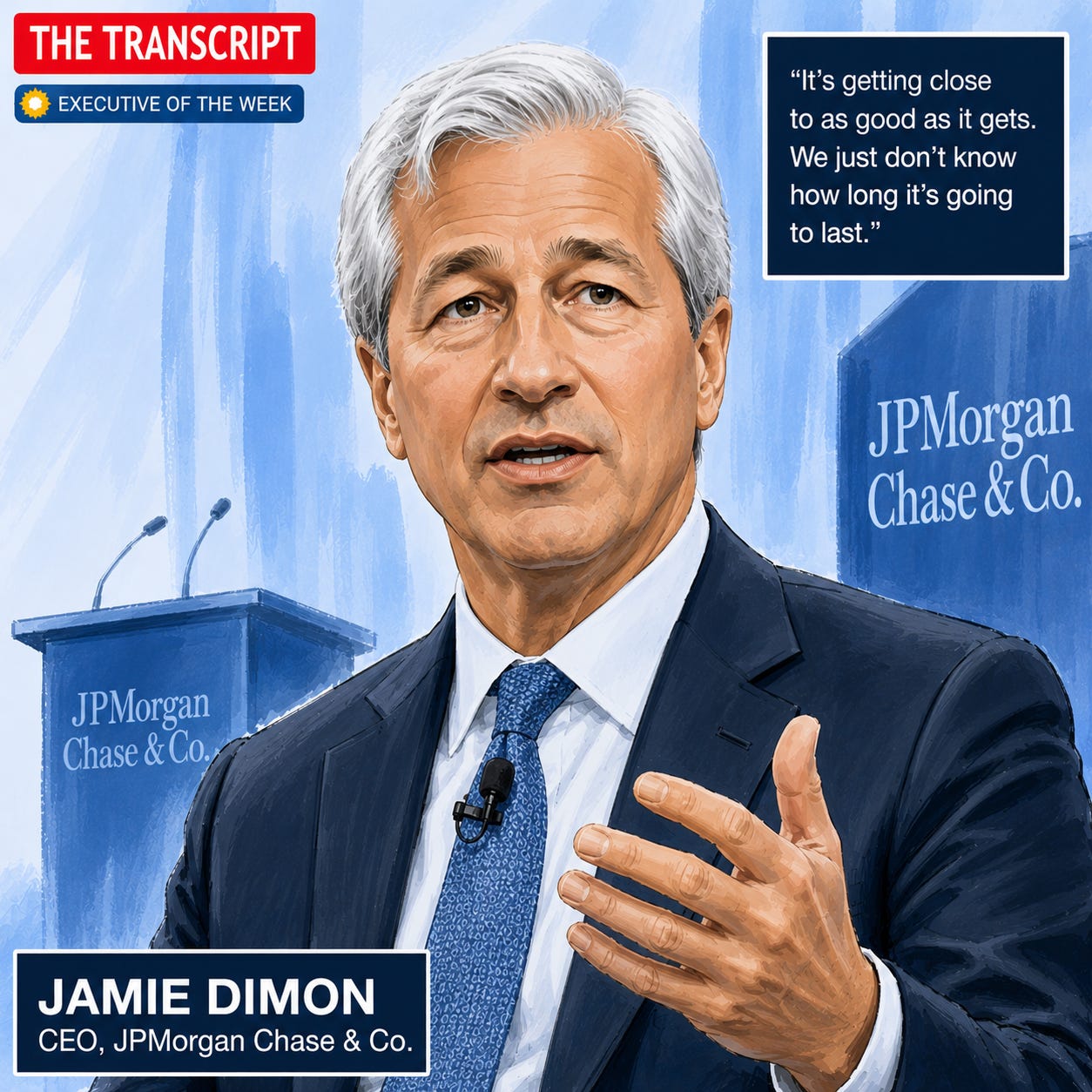
“It’s getting close to as good as it gets. We just don’t know how long it’s going to last.” - JPMorgan Chase (JPM 0.00%↑) CEO Jamie Dimon
“Strong environments like this don’t last forever, and we see large amounts of capital being deployed by both banks and nonbanks across a broad range of risk assets. Often, when times like this continue, leverage and risks develop that are sometimes hard to see.” - Wells Fargo (WFC 0.00%↑) CEO Charles Scharf
International
Industrial production in China has slowed
“...industrial production slowed to 4.3% in April and May from 6.1% YoY in Q1, partly reflecting lower oil supply entering the industrial production value chains. This has been evident in the sequentially weaker output of chemicals and processed petroleum products. Exports continue to surge, reinforcing the theme of soft domestic consumption and strong exports.” - Rio Tinto (RIO 0.00%↑)
ETF adoption is growing in Europe
“Well, first and foremost, the growth in ETFs in Europe is experiencing the same type of curve that the U.S. did. Obviously, maybe 5 to 8 years later, with the adaptation of using ETFs, as you called it, the democratization of investing in Europe is growing… moving away from the total reliance of bank and bank savings to growing with your country, we’re seeing this more and more worldwide. And it’s showing up vividly in Europe.” - BlackRock (BLK 0.00%↑) CEO Laurence Fink
Financials
Banks posted record results
“Morgan Stanley again delivered top-line and bottom-line record results, with revenues exceeding $21 billion and EPS of $3.46, marking an exceptional first half for 2026. $42 billion of revenue, $6.90 in EPS, and a 27% return on tangible.” - Morgan Stanley CEO Ted Pick
“The team delivered one of our strongest quarters to date, with earnings per share up 34% year-over-year.” - Bank of America (BAC 0.00%↑) CEO Brian Moynihan
“With net income up 45%, this was Citi’s best quarterly revenue in a decade with double-digit revenue growth for the firm and in four out of our five businesses” - Citigroup (C 0.00%↑) CEO Jane Fraser
It has been a particularly favorable environment
“These results were the product of a particularly favorable environment with an elevated level of market activity, as well as rigorous execution, years of consistent investment and thoughtful capital deployment.” - JPMorgan Chase (JPM 0.00%↑) CEO Jamie Dimon
Capital markets are extremely risk-on
“Not to be pedantic, I think the question, the we matters, right? The market is clearly extremely risk-on. We are kind of takers of that, and we are trying to strike the right balance between supporting all our clients and being appropriately cautious in an environment that has some complicated dynamics in it.” - JPMorgan Chase (JPM 0.00%↑) CFO Jeremy Barnum
“Look, the level of activity is very strong. The pipeline is very healthy. We’re also in a financial market that’s sort of looking for reasons to buy. I think the central CEO question right now across sectors is do we invest for growth now or are we preserving optionality?” - Citigroup (C 0.00%↑) CEO Jane Fraser
AI is dominating a lot of the conversation
“AI is dominating a lot of the conversation. Tech, data center, energy, defense, CapEx is accelerating...Wherever there’s a bottleneck in that whole energy, power, compute memory ecosystem, we’re seeing a lot of activity.” - Citigroup (C 0.00%↑) CEO Jane Fraser
CEOs are looking for scale advantage
“I think the most important thing that is driving the backlog activity is really strategic M&A. We are just in an environment where if you think about what is going on with technology change and scale broadly, if you are running a big business, you have to be focused strategically on scale advantage...CEOs are dreaming and thinking about really large, structurally scale-enhancing opportunities, that is leading to just a lot more strategic activity” - Goldman Sachs (GS 0.00%↑) CEO David Solomon
Debt and equity markets are open
“The second piece that I would mention is specifically this began as a cycle really around debt. We saw a lot of issuance, both investment grade, and then we saw the non-IG space, and now we’re seeing the equity side.” - Morgan Stanley CFO Sharon Yeshaya
Will there be a lull?
“We have to see. We’ll probably have the summer lull, as everyone takes a bit of a break. We’ll have midterms coming up, and the wild card really is geopolitics. We’re certainly entering the H2 with a good pipeline.” - Citigroup (C 0.00%↑) CEO Jane Fraser
Investment banking activity still has room to improve
“I would actually bifurcate that a little bit between investment banking and markets. In the sense that by historical standards, investment banking fees were fine, but they weren’t at sort of super peak levels, so they had some room to come up a little bit...I think clearly there was some pull forward, and clearly the large deals contributed meaningfully to the quarter results...I think the particular set of things that happened in equities this quarter, it is a little bit hard to imagine that being repeated.” - JPMorgan Chase (JPM 0.00%↑) CFO Jeremy Barnum
“While sponsor volumes are still subdued versus historical averages, this represents a meaningful source of potential upside as activity picks up.” - Goldman Sachs (GS 0.00%↑) CFO Denis Coleman
Credit quality is good
“When you look at the delinquencies and the net credit losses, you can see that across the portfolios, right, both delinquency and credit losses are down year on year.” - Citigroup (C 0.00%↑) CFO Gonzalo Luchetti
“...we now expect card net charge-off rate to be approximately 3.2%, reflecting better-than-expected consumer credit performance.” - JPMorgan Chase (JPM 0.00%↑) CFO Jeremy Barnum
“Our credit performance in the second quarter remained strong with our net loan charge-off ratio down 10 basis points from a year ago to 34 basis points of average loans.” - Wells Fargo (WFC 0.00%↑) CFO Michael Santomassimo
No signs of emerging stress
“I mean, overall, credit quality is very good on both the consumer side and the commercial side. And we don’t see any big pockets forming. We follow sort of the pressures in the health care industry. There’s pressures in the distillery sector. There are some pressures in transportation around fuel costs, those sorts of things. All the things that you read about and are well aware. But I wouldn’t say there’s any big pocket or anything that’s particularly worrisome beyond that.” - The PNC Financial Services (PNC 0.00%↑) CFO Robert Reilly
Loan demand remains strong
“...the demand for deposits and lending continue to probably put a little bit of pressure on relative spreads on both sides of the balance sheet as this economy continues to churn forward in a very positive fashion.” - First Horizon (FHN 0.00%↑) CEO Bryan Jordan
“We grew loans at an annualized rate of 11.6% and deposits at 7.7% annualized” - FBK — The Transcript
BlackRock’s AUM is now $15 Trillion
“Clients entrusted BlackRock with $192 billion of net inflows in the second quarter, contributing to our strongest first half on record. Flows in the first 6 months are more than double what we saw in the first half of 2025, driving AUM to a record $15.3 trillion.” - BlackRock (BLK 0.00%↑) CEO Laurence Fink
Consumer
JPM and WFC don’t see evidence of a K-shaped economy
“There’s some of that economic heterogeneity data came out from the Fed recently, which also I think doesn’t give a lot of support to the K-shaped narrative, essentially. Again, we think about this, we worry about this, we look at it, but from our perspective, through all the various dimensions, there’s not like that much there in terms to support the K-shaped narrative.” - JPMorgan Chase (JPM 0.00%↑) CFO Jeremy Barnum
“We’re not seeing sign any -- we’re not seeing any cohorts of clients, whether you break it by FICO or other ways to look at higher or lower income levels. We’re not seeing any of the trends in any of the cohorts change really at all, certainly not anything meaningful” - Wells Fargo (WFC 0.00%↑) CFO Michael Santomassimo
Spending is rotating across categories rather than collapsing
“I’m not going to put an alphabet letter on the shape of the economy, but you do see in some of these consumer-sensitive areas, people are reallocating where they’re spending. They are still spending less on certain categories like dining out, more on fuel and things of that nature. But overall, as Tom said, the consumer is still holding up very well” - First Horizon (FHN 0.00%↑) CEO Bryan Jordan
Luxury demand remained globally resilient
“So our top line numbers, sales for the year of GBP 1.828 billion, up 13% on last year in constant currency. The U.S. was plus 24% in constant currency, which saw it become our largest revenue and profits market, and the U.K. was plus 5% on last year.” - Watches of Switzerland (WOSGF) CEO Hugh Duffy
“Sales rose across all regions, with notable double-digit increases in Europe, the Americas, Asia Pacific and Japan, whilst Middle East & Africa returned to growth” - Richemont (CFR 0.00%↑)
Labor markets drive consumer spending
“As I always say, when it comes to consumer credit performance, it’s just about the labor market. You’re not going to hear anything from me that’s new or differentiated about the labor market. Like we all see the same numbers, and it’s been surprisingly resilient. For now, that’s the narrative.” - JPMorgan Chase (JPM 0.00%↑) CFO Jeremy Barnum
Uber Eats has expanded from below 10% to ~50% of Uber bookings
“So Uber Eats for us, I think when I joined, was like less than 10% of our bookings and now is 50% of our overall bookings and growing faster than our mobility business. So ultimately, from a top-line standpoint, it will be bigger.” - Delivery Hero (DELHY) Uber CEO Dara Khosrowshahi
Technology
Questions about ROI are a risk to the AI industry
“I think the biggest risk for everyone is when the question is asked, which it often is, how do you get to an ROI? That’s going to force our teams to do something short-term and tactical. You can always do a cost cut to get something to drop to the bottom line, and that is not a way to build a great company....So I think the risk is don’t be so in the moment maniacally focused on what is it, but have a right mix of an engine that’s continuing to drive the business, which also explains why you need to start building early for growth so that you can grow into it.” - Alphabet (GOOG 0.00%↑) President and CIO Ruth Porat
A lot of people are asking the question about ROI
“I think you’re at a very early stage. So, you know, obviously, a lot of CEOs are talking about what is the return A.I.? How do you look at the NPV? Should you even look at NPVs?...They all see the costs going up rapidly. So, of course, we’re all going to be rational about it like any other resource we use. And, you know, and we, we negotiate with vendors all the time about, you know, what’s the value to us and why we want it.” - JPMorgan Chase (JPM 0.00%↑) CEO Jamie Dimon
Companies are routing appropriate tasks to cheaper models
“A lot of the infrastructure that we’ve built over the last couple of years is going to position us to be quite sophisticated about using the right models for the right purpose. I mean, just to use one sort of topical example, no offense intended to those of you who tend to write slightly long reports, as you can imagine, sometimes people like to summarize those reports using AI tools. As you know, the tools are quite good at doing that, and you really don’t need the latest cutting-edge, incredibly expensive model to summarize an analyst report.” - JPMorgan Chase (JPM 0.00%↑) CFO Jeremy Barnum
The strategy is to use expensive frontier American models only for the most difficult questions. For routine tasks such as extracting a field from Salesforce, summarizing it, and entering it into Workday, a cheaper open-source model is sufficient” - Databricks CEO Ali Ghodsi,
Token expense is still a trivial expense for JPM, but growing
“I think one topic which is not financially meaningful this year, but which I think is interesting and may become in the future, is the question of token expense. That is something that we’re spending a bunch of time on, I think as probably pretty much everyone in corporate America is. Just for the avoidance of doubt, it is a trivial number for the H1. We are forecasting some meaningful acceleration in that number for H2 of the year. Still, nonetheless, the full-year contribution of that is still trivial. Obviously, we had budgeted some of that, so it’s not in any way a meaningful driver of the current outlook or to the revision of the outlook. Obviously, when you listen to the Frontier Labs talk, they talk about the exponential and the acceleration of usage, which is obviously driving their revenues, and someone’s paying those bills. We’re, in a sense, a representation of the economy as a whole; we’re probably lagging a little bit some of the cutting-edge adoption and usage as we should given who we are as a company. It is an important question for us as we go into next year and the subsequent years.” - JPMorgan Chase (JPM 0.00%↑) CFO Jeremy Barnum
Most CEOs expect that AI will help drive efficiency and perhaps lower headcount
“And so given the size of our business, the activity levels we’ve got, we expect that we should be able to run this company with less headcount that we’ve got today. Certainly, technology and AI help us get at aspects of that in a different way or faster than maybe in the past, but we expect that we’ll continue to see more efficiency from here.” - Wells Fargo (WFC 0.00%↑) CFO Michael Santomassimo
Falling token costs are key to adoption
“The best way you’re going to continue to get large-scale agentic adoption is by continuing to bring down the cost of intelligence. More use cases open up for AI every time you can have lower-cost tokens (for the same or better level of capability). Almost all information work in the future will involve an agent somewhere in the workflow creating, processing, reviewing, or classifying data in some way. This will happen sooner or later, depending on the cost of tokens of frontier models. Whether this happens from closed or open models is somewhat incidental, but the key is just that it happens. It’s great to see so much innovation and different approaches in AI right now as there are so many more use cases to power.” - Box (BOX 0.00%↑) CEO Aaron Levie
Analysts are forecasting $10 Trillion in capex
“AI CapEx expectations continue to move up. The forecast for 2026 on data center CapEx that was taken late last year, around November of 2025, was that $575 billion would be spent this year, and it’s coming in at about $850 billion. That for 2027, the view was it would be around $700 billion, and now it’s projected at $1.3 trillion. 2028 could be at $1.5 trillion. Our excellent research team, led by Katy Huberty, would observe that each major tech cycle has produced a 10-fold increase in compute capacity. Applied to AI, that would suggest a progression from roughly the last transformation, I think we’d agree was cloud. Roughly $1 trillion of cloud compute times 10 is $10 trillion of AI compute. If you think about the numbers I reeled off before, the $575 billion feels like $850 billion, the $700 billion feels like $1.3 trillion for next year, and then maybe $1.5 trillion after that. You’re basically looking at us being around 10%-15% of the way through the investment cycle.” - Morgan Stanley CEO Ted Pick
“Just give you the big numbers. I think CapEx is about $4 trillion a year, and AI went from $400 billion last year to $700 billion this year. People project, which so do our people, it’ll be like a little over a trillion next year. Maybe a little reduction in the non-AI CapEx. That’s hard to figure out because that’s the same people, some of the same people doing the same.” - JPMorgan Chase (JPM 0.00%↑) CEO Jamie Dimon
Suppliers have a lot of confidence
“You want me to give you a guarantee, right? Let me say that. I believe from this day on, all the way to probably 2029, 2030, the demand is very strong. Whether in between, there’s a dip or not, I’m not very sure. The trend is so robust that I believe we are witnessing a kind of a new industry. I would like to say the new industry called AI industry, which is so common in our daily life because it’s going to affect our automotive, affect the humanoids, robot, and also impact to all the industry. By the amount of money we put in, including all the CSPs, this alone is a very important new industry to the world. The demand will be there. The fundamental thing is semiconductor chips, and most of them in TSMC....Thus, our conviction in the multi-year AI megatrend remains very high.” - TSMC (TSM 0.00%↑) CEO C.C. Wei
But near-term resets in AI investment are possible
“Now, we all know, because we’ve all been around for a long time, that these things don’t go in a straight line, they can ebb and flow. I’m not smart enough to tell you whether or not there can be resets or recalibrations in the short term, sometime in the next six months, the next 18 months. I will tell you that when you look over a three-year period or a five-year period, we’re investing in long-term growth to support this, and we’re going to continue to be very consistent about that...I think that’s one of the lessons that we can take when you have these accelerations. Ultimately, you will have a recalibration, a reset, a drawdown, and then a further acceleration. That’s what the path generally looks like.” - Goldman Sachs (GS 0.00%↑) CEO David Solomon
The AI industry says AGI may be the most important technological discovery since fire
“I’ve spent my whole life working on AGI because I’ve always had a deep conviction that, if built and deployed responsibly, it would prove to be one of the most beneficial and transformative technologies ever invented. AGI cannot be compared to standard technological breakthroughs, not even ones as consequential as the internet or mobile - it is much more akin to the discovery of electricity or fire. If you stop to think about it, we’ve essentially found a way to make sand think. It’s miraculous. The magnitude of this technology’s impact will be unprecedented, perhaps 10x of the Industrial Revolution at 10x the speed. It will help us solve some of the biggest problems society faces from accelerating drug discovery to developing new clean energy sources to creating novel advanced materials. We could even reach a point where resources are no longer the limiting factor for human progress, leading to an amazing new era of abundance” - Alphabet (GOOG 0.00%↑) Google DeepMind CEO Demis Hassabis
CEOs are focused on cybersecurity risk
“Mythos is making people pause to say, wait how much do I need to spend on cyber? They’re pausing on new deals until they know…We don’t see our software being disrupted by ai at all..clients were distracted with rapidly-evolving, industry-wide cybersecurity concerns in the quarter” - IBM (IBM 0.00%↑) CEO Arvind Krishna
How should we regulate AGI?
“The rapid progress we’re seeing in AI requires a new approach to testing frontier AI model capabilities that is dynamic, adaptable, and rigorous. The US is well positioned, given its economic and technical standing, to take the first step in developing such a framework. It could establish a new Standards Body modelled on a federally overseen public-private partnership or self-regulatory organisation, much like the Financial Industry Regulatory Authority (FINRA), with a board that includes independent leading technical experts and open-source representatives. Funding would need to be substantial and likely mostly come from industry, in order to attract world-class technical talent and provide the necessary compute resources for large-scale testing.” - Alphabet (GOOG 0.00%↑) Google DeepMind CEO Demis Hassabis
Buffett is betting on Google being an AI winner
“I initiated it. I mean, I normally wouldn’t give you an answer on something like that, but I will, because it, but we, I am not doing anything that he doesn’t approve of. He’s not doing anything I don’t approve of. We talk all the time. He’s, well, every day, I mean, and, but he is the decider. And getting back to Alphabet, or Google, it’s probably number five or six....I think they’re more likely to be a winner based on the record than probably 90 percent or 95 percent of what gets merchandised through Wall Street, because Wall Street, it’s just whether they can sell something” - Berkshire Hathaway (BRK.B) Chairman Warren Buffett
Industrials and Transport
Industrial conditions remain modestly positive
“During Q2, the industrial environment remained stable and modestly positive, consistent with the trend we saw in Q1. US PMI averaged slightly above 53 for the quarter, up from 52 last quarter, and industrial production was slightly positive year-over-year in April and May. This lines up with the gradual improvement that started late last year...We’ve now had 6 months of 50-plus PMI.” - Fastenal (FAST 0.00%↑) CFO Max Tunnicliff
Freight demand and supply conditions have improved
“In the second quarter, overall freight demand improved modestly from the first quarter. Demand in many industrial markets is improving and U.S. consumer demand remains resilient...It is increasingly clear that the freight market has changed. Capacity has tightened across the industry as safety-focused enforcement and broader supply pressures continue to affect available truckload capacity.” - J.B. Hunt Transport Services (JBHT 0.00%↑) Executive VP of Sales and Marketing Spencer Frazier
Delta and United both delivered strong quarters
“We generated record revenue, which grew 14%, increasing more than $2 billion over last year. This reflects sustained strength in demand and momentum across our diversified business. We delivered pretax profits of $1.4 billion, earnings of $1.56 per share, and an operating margin of 9%, all better than the guidance that we provided at the start of the quarter.” - Delta Air Lines (DAL 0.00%↑) CEO Ed Bastian
“United’s revenue accelerated across the board in Q2 with total operating revenue up 16% to $17.7 billion. TRASM was up 12.1% year-over-year with load factors up slightly, which indicates strong demand for United’s products. We observed minimal to no negative impact on demand from higher price points, a trend we see continuing.” - United Airlines (UAL 0.00%↑) CCO Andrew Nocella
Delta’s customers are flying despite higher fares
“Our business model is geared towards a higher-end consumer. So our consumer has the ability to sustain this level. In fact, we saw it in the quarter.” - Delta Air Lines (DAL 0.00%↑) CEO Ed Bastian
Many airlines are struggling, though
“It takes time, but economic gravity always wins. And the reality is this year, 4 of the 8 publicly traded commercial airlines are probably going to lose money. They have an awful lot of flying that loses money on an individual route basis. And one way or another, that gets resolved over time. I’m not going to try to predict when. I’m not going to predict exactly when it happens. But I think that probably drives us into the mid-teens margin range.” - United Airlines (UAL 0.00%↑) CEO Scott Kirby
The airline industry has removed significant unprofitable capacity
“Well, actually, in the second quarter, our unit revenue in main cabin did exceed premium because we are down in capacity. And the industry has removed a significant amount of unprofitable capacity. If you look at the ultra LCC category, that capacity is down about 30%. So main cabin has gotten significantly healthier this year. I mean, last year, it was one of our biggest objectives to improve the main cabin.” - Delta Air Lines ( DAL 0.00%↑) CCO Joe Esposito
Low cost carriers need to increase fares to achieve profitability
“The fact that you’ve got others in the industry following our lead is no surprise as well. But I mentioned a point on the call this morning, that even with the improvements we’ve seen in pricing for the industry, the low end of the market still has to increase fares by another 5% by our estimate, just to get to breakeven at today’s fuel environment. And there’s nothing to be gained by trying to grow in that environment. The opportunity has to be in finding ways to secure higher revenues, not higher market share.” - Delta Air Lines (DAL 0.00%↑) CEO Ed Bastian
Airfares remain 10–15 points below broader inflation since COVID
“Even after recent fare increases, airfares remain 10 to 15 points below overall inflation since COVID. With continued fuel volatility and much of the industry is still earning returns below its cost of capital, we believe current revenue momentum should remain sustainable even if fuel prices moderate. That is an important step towards improving the industry’s financial health and earning sustainable returns over time.” - Delta Air Lines (DAL 0.00%↑) CEO Ed Bastian
Materials & Energy
Higher for longer oil
“I think oil is going to stay sticky for longer. I’m not sure it’s gonna be in crude, though. I think the refined cost or crack spreads are where you’re gonna find it’s gonna take a lot longer for that to come, come down.” - Delta Air Lines (DAL 0.00%↑) CEO Ed Bastian
Nuggets of Wisdom
Warren Buffett views himself as one of the 10 luckiest people in the world
“...the perspective I have is that, out of eight billion people, I may be one of the 10 luckiest in the world. And so I have been lucky and healthy to get to 95. I have been lucky in that the field that intrigued me and where I had some natural ability happened to be one that paid off in a way that nothing paid off like it, if I had been a great violin player or anything else. It requires more talent than I have, but a different form of talent, and, fortunately, I got exposed, partly accidentally, to what I liked to do very early on, and that was just an accident. If my father had been a plumber, I would not have, I would not have had the same advantage I had. So I was incredibly lucky. And then, as life has gone along, I have seen how unbelievably unlucky some people have been. And it is luck. I mean, we had accidents with the kids when they were young, and all kinds of things can happen. And they just didn’t happen to us.” - Berkshire Hathaway (BRK.B) Chairman Warren Buffett
Incrementalism leads to irrelevance
“When I was still at Morgan Stanley, we had taken Google public, and so I still was reading all of the founders’ letters. There was a founders’ letter back in 2013, and Larry Page at the time wrote that incrementalism leads to irrelevance because change in technology is revolutionary. It’s not evolutionary. And I think it’s really important for each of us. There’s actually a lesson I learned earlier at Morgan Stanley: if you don’t invest for the long run, you are sowing the seeds of your own destruction. And when you see a technology that can be this transformative for each of our businesses, I’ll go back to my ‘why not’ question. If we’re each asking ‘why not’ and doing something bold and profound in building for long-term growth, it makes a difference.” - Alphabet (GOOG 0.00%↑) President and CIO Ruth Porat