
Catalyst Watch
Stealing Alpha

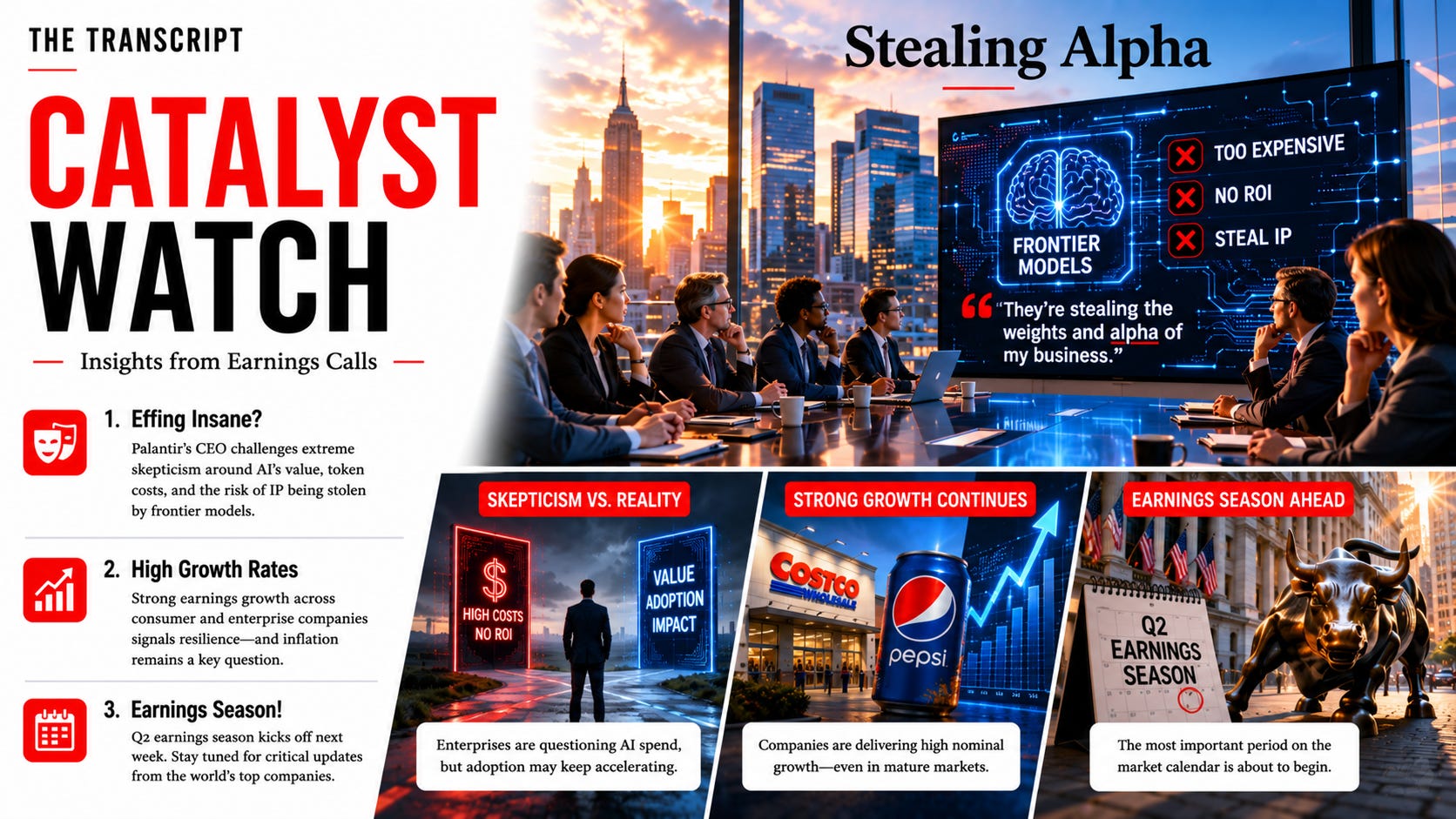
Welcome to Catalyst Watch at The Transcript, a report for paid subscribers that highlights investment themes from this week’s newsletter.
1. Effing Insane?
Palantir’s CEO, Alex Karp, was on CNBC a couple of weeks ago and gave a passionate interview in which he highlighted what he sees as extreme skepticism about the value of AI to enterprise customers. Here’s an excerpt:
“Are we really gonna outsource the battlefield of this country to the consensus view in Silicon Valley? That is effing insane. And by the way, every single enterprise in this country in private, a lot of them don’t wanna speak in public because it get outs- it gets outsourced to the neurodivergent crazy person that apparently is on drugs, the one thing I don’t do...But I’m telling you, in this country at every single enterprise I deal with, they, these people are livid. They’re like, “I am paying for tokens that create no value. These people are stealing the weights and alpha of my business…these models have been completely over- irresponsibly oversold.” - Palantir (PLTR -3.00%↓) CEO Alex Karp
Karp’s key arguments in the interview were that frontier models are too expensive to produce ROI for enterprise customers and that they steal IP from their users. Without passing judgement on what Karp is saying, it’s worth noting that he’s selling his own competing solution, so his comments should be interpreted with that bias in mind.
Still, Karp is clearly touching on a narrative that has grown in intensity over the last several weeks. Enterprises are heavily focused on containing AI spending. At this point, the narrative has gone broad enough that it would be surprising if it didn’t have an impact on the frontier labs’ growth trajectory.
The investment environment around AI has been so hot that any change in trajectory conjures up fears of a bust. The potential ramifications of an AI bust even got a shout-out from the Bank of International Settlements in its annual economic report.
“As competitive pressure drives capex higher, the net economic surplus – the total payoff less investment costs – declines for the sector as a whole and could turn negative in adverse scenarios. Disappointment in returns could trigger a sudden pullback in financing and turn the capex boom into a protracted investment bust, with potential knock-on effects on financial conditions.” - Bank of International Settlements
Are we headed for a bust? Maybe. But this also isn’t the first time that there’s been concerns over the ROI on AI spending, and usage has continued to surge. Especially since AI has been billed as a threat to humanity, most of us probably have a similar underlying bias to Karp–towards skepticism. In the short term, markets could certainly sell off or even crash, but in the long term, the trajectory of the technology seems to still be towards greater and greater adoption.
2. High Growth Rates
Amid AI hype, it’s easy to overlook the high nominal growth rates that are propelling the stock market. Ken Griffin pointed this out last week:
“And you talk about the S&P at all time highs. Corporate earnings in America are at all time highs. It’s unbelievable the growth earnings over the course of just the last 12 months, right? So, there is a technological revolution happening of which AI is a component of the story. But it’s just a piece. I think that’s important point number one.” - Citadel Founder Ken Griffin
Costco’s growth apparently disappointed analysts, but it still reported 10.6% growth in June, the bulk of which came from the US.
“Net sales for the month came in at $29.24 billion, an increase of 10.6% from $26.44 billion last year. Reported comparable sales for the month were as follows: U.S., 10.6%; Canada, 3.7%; Other International, 4.7%; total company, 8.8%; digitally enabled 20.9%. Comparable sales for the month, excluding the impacts of changes in gasoline prices and foreign exchange were as follows: U.S., 7.6%; Canada, 4.9%; Other International, 5.6%; total company, 7.0%; digitally enabled 21.5%.” - Costco Wholesale (COST 0.82%↑) Director of Financial Planning Andrew Yoon
Gasoline prices were a significant driver of the sales growth, but even without the gas impact, sales were up 7.6% in the US. This was a similar growth rate to the one reported by Pepsi:
“So if you step back, the company, the first half reported almost 7% revenue growth. And we’ve grown global volumes 3% in foods and 2% in beverages. That’s the fastest growth in volume since 2022.” - PepsiCo (PEP 0.40%↑) CEO Ramon Laguarta
Companies in mature markets like Pepsi should probably be growing more like 2-3% per year, which matches the volume growth reported here. The rest of the growth is presumably coming from price increases (i.e., inflation).
Inflation is clearly still running quite hot in the economy. Is inflation going to subside? And if not, does the current interest rate regime fully reflect this?
3. Earnings Season!
Earnings season starts next week.
Sign up as a paid subscriber for full access to content, including Catalyst Watch.