
Catalyst Watch
Short Memory

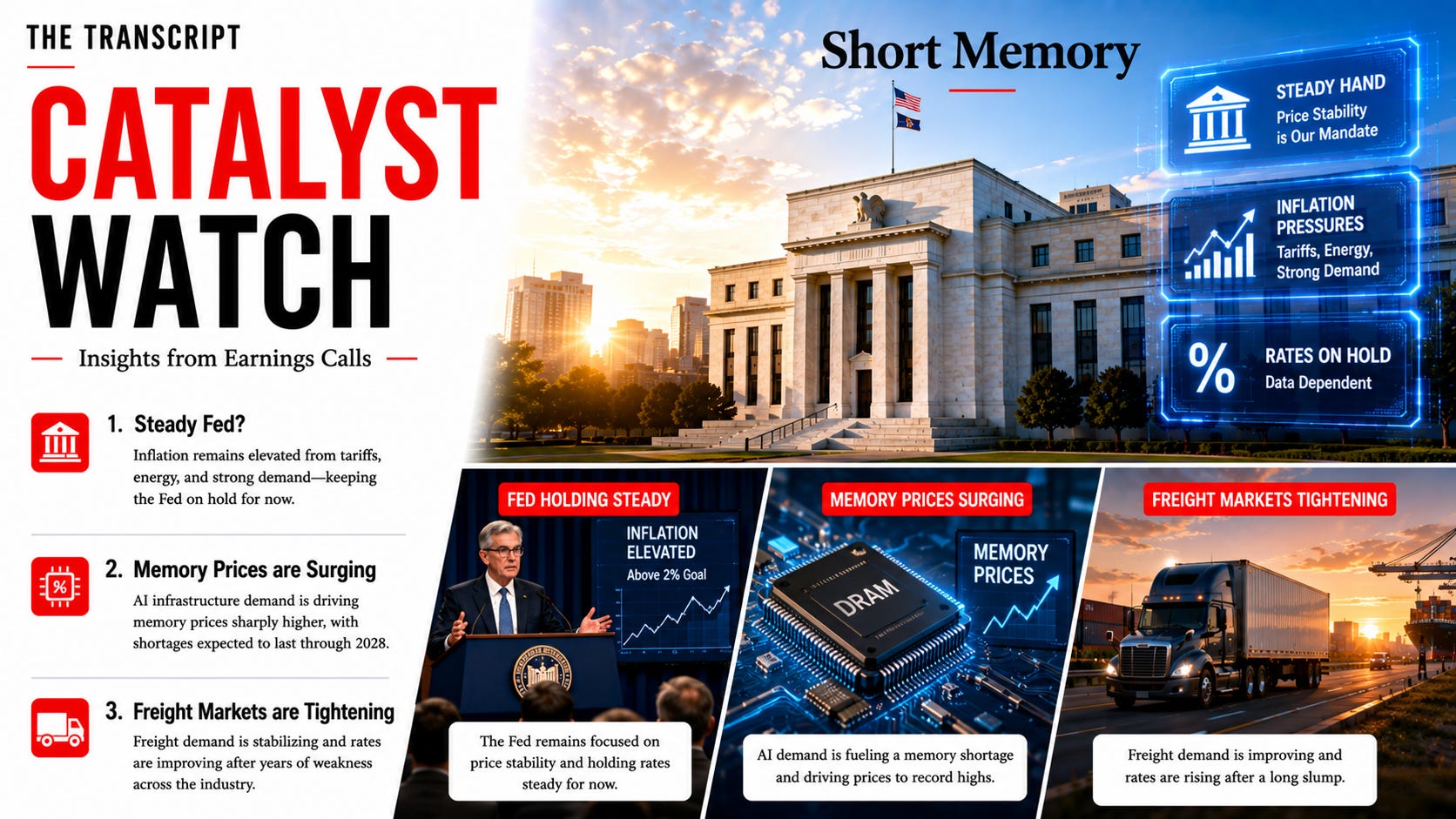
Welcome to Catalyst Watch at The Transcript, a report that highlights investment themes from this week’s newsletter. This week’s edition is available to all subscribers.
1. Steady Fed?
Two weeks ago, Kevin Warsh established a new communication philosophy at the Fed. Markets are still digesting the implications of this change, but for now, the Fed is expected to hold interest rates steady. This view was supported by comments from NY Fed President John Williams last week:
“On the price stability side of our dual mandate, inflation is unquestionably elevated and well above the FOMC’s longer-run goal of 2 percent. The rise in inflation primarily reflects three drivers: the effects of increased tariffs on imported goods, higher energy and commodity prices owing to the conflict in the Middle East, and robust demand for certain categories of technology goods related to the AI investment boom.” - New York Fed President John C. Williams
There’s hope that the end of conflict with Iran will lead to a decrease in inflation pressure. The ceasefire still appears fragile, though, as captured in comments from Phillips 66’s CEO:
“And so there’s a lot of moving parts. You hear the President say one thing, you hear the Vice President say another thing, you hear the Iranians say a third thing. And so this MOU really is an agreement to try to reach an agreement, and it’s pretty thorny, and I think it’s going to take time to work out.” - Phillips 66 (PSX 0.56%↑) CEO Mark Lashier
Inflation pressure isn’t wholly contained to energy prices either. Other raw materials prices are rising, according to comments from H.B. Fuller’s management team:
“I’ll start with the raw material question, Jeff. So as we monitor 4,000 different raw material categories, what we are still seeing versus Q1 is that almost 90% of our raw materials are higher than they were in Q1. So we’re not seeing...a turn in raw material pricing.” - H.B. Fuller (FUL -5.60%↓) CEO Celeste Mastin
2. Memory Prices are Surging
AI infrastructure spending is becoming its own inflationary force on the economy. Micron reported earnings last week and put the spotlight on memory prices. Micron’s revenue was up more than 300% y/y and 67% sequentially, driven primarily by price increases. Volume growth was only mid-single digits.
“Fiscal Q3 DRAM revenue was a record $31.3 billion, up 343% year over year, and represented 76% of total revenue. Sequentially, DRAM revenue increased 67%. Bit shipments were up low-single-digit percentage range. Prices increased in the low-60s percentage range, driven by tight industry conditions and a favorable mix.” - Micron (MU 1.56%↑) CFO Mark Murphy
This pricing pressure is leading consumer electronics companies to announce price increases, most notably Apple:
“The rapid expansion of AI data centers has created an extraordinary surge in demand for memory and storage...Have never seen a component price increase this much, this quickly. We have shielded our customers from these increases so far, but we have now reached a point where we need to begin raising prices on a number of products, including today’s increases for iPad and Mac.” - Apple (AAPL -1.80%↓)
The memory shortage is expected to last at least through 2028. New supply requires greenfield expansion, and that takes time:
“Memory industry supply growth is dependent on significant greenfield fab expansions. These greenfield projects are large, complex, and time-consuming. Further, the pace is constrained by several factors, including long lead time for fab construction across the world, shortage of workers with critical trade skills, complex regulations including permitting, and the need for enhanced energy infrastructure. Meanwhile, memory process technology, which is among the most advanced to develop and manufacture in semiconductors, is getting more complex with every new node.” - Micron (MU 1.56%↑) CEO Sanjay Mehrotra
It’s extraordinary to think about these shortages in the context that, as recently as 2023, the memory industry found itself under pricing pressure and shut down investment due to concerns about oversupply.
“We told a couple of the customers who were being very aggressive with pricing at that time that this is not constructive. A lot of the industry investments got shut down in 2023 because of really poor pricing and really poor margins.” - Micron (MU 1.56%↑) Chief Business Officer Sumit Sadana
It’s a reminder of how much has changed in the last few years and how quickly things could change again.
3. Freight Markets are Tightening
For the last several years, we’ve published quotes from companies in the freight industry talking about one of the deepest, most prolonged recessions that the industry has ever experienced. So it’s noteworthy that there appears to be a change happening. FedEx noted that conditions are stabilizing:
“We are seeing some pretty good encouraging signs that demand conditions are beginning to stabilize and even increase across the industry. So the leading indicators, as you well know, that we watch are the ISM manufacturing activity, trends in the truckload spot rates and capacity, and the early signals, the demand is showing positive signs across the industry. So we have really watched that and from a driver perspective, we feel really good about where we stand.” - FedEx Freight Holding (FDXF -1.96%↓) CEO John Smith
A quick glance at trucking stocks shows that prices have already bounced a fair amount from their bottom, so it’s unclear if they’ve already discounted this improvement.