
Catalyst Watch
A New Chapter

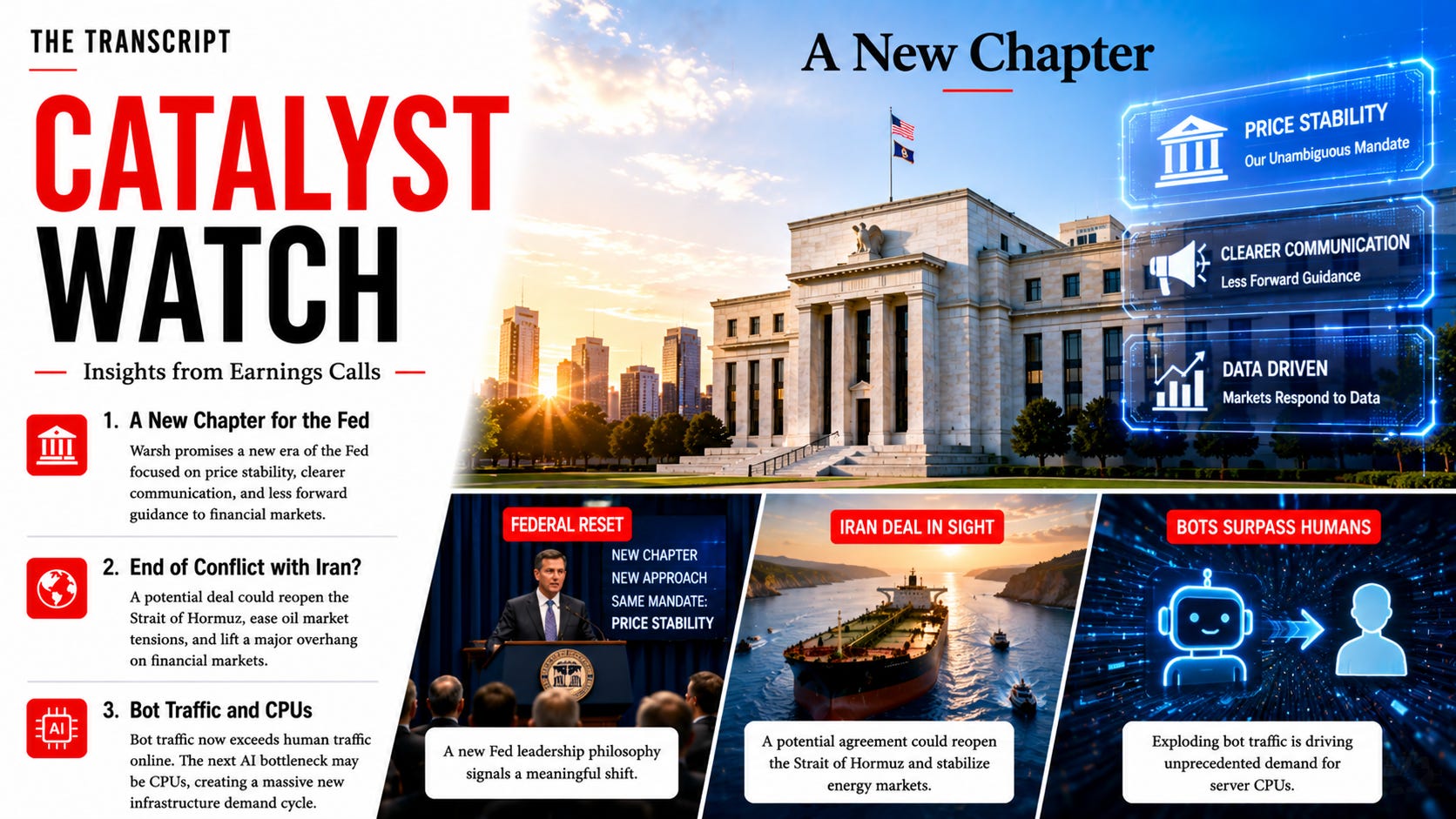
Welcome to Catalyst Watch at The Transcript, a report for paid subscribers that highlights investment themes from this week’s newsletter.
1. A New Chapter for the Fed
Last week, the Fed met for the first time with Kevin Warsh as chairman. He promised a new chapter and a commitment to price stability.
“What we’ve given markets is a new chapter for the central bank, some fresh thinking.”
“I am pleased to report that members of the FOMC are unambiguous and unanimous. This committee will deliver price stability.”
His top area of focus appears to be changing the way in which the Fed communicates with markets. At face value, it appears that the Fed will be communicating less about its forward expectations.
“Since last summer, my colleagues discussed possible improvements in the form and function of Fed communications…We’ve dropped forward guidance...as a general proposition, forward guidance isn’t the business we should be in.”
Philosophically, Warsh explained why he thinks it’s important that the Fed move in a different direction. He thinks that Fed communication is distorting markets:
“I think financial markets perform best when they react to incoming data. I think the financial markets work less efficiently when they ask a question: How will the Federal Reserve react to that incoming information? The more that markets are paying attention to what’s happening in the real economy, deciding what’s good data and what’s less-good data, the more financial markets can price what they believe is the most likely and what are the tail risks. Financial market prices are probably the most important source of information to guide central bankers. But when all the financial markets are doing is reflecting back what we’ve said, then we’re taking the most important source of information and we’re being blind to it. I’d like us to create a system where those blinders come off, where markets are following data that they efficiently think is reliable, and they’ll be watching data, we’ll be watching data, they’ll come with better information through market prices to us. We can make more-informed decisions with, ultimately, the goal that I set at the outset: Deliver on the price stability objective that Congress told us to do and that we’ve got to get in the business of doing.”
Warsh’s new philosophy is intriguing in some ways, but it also has the potential to create new forms of uncertainty for financial markets. In general, uncertainty usually serves to increase the cost of capital and create volatility.
