
A New Chapter
Fed Chair: What we’ve given markets is a new chapter for the central bank, some fresh thinking

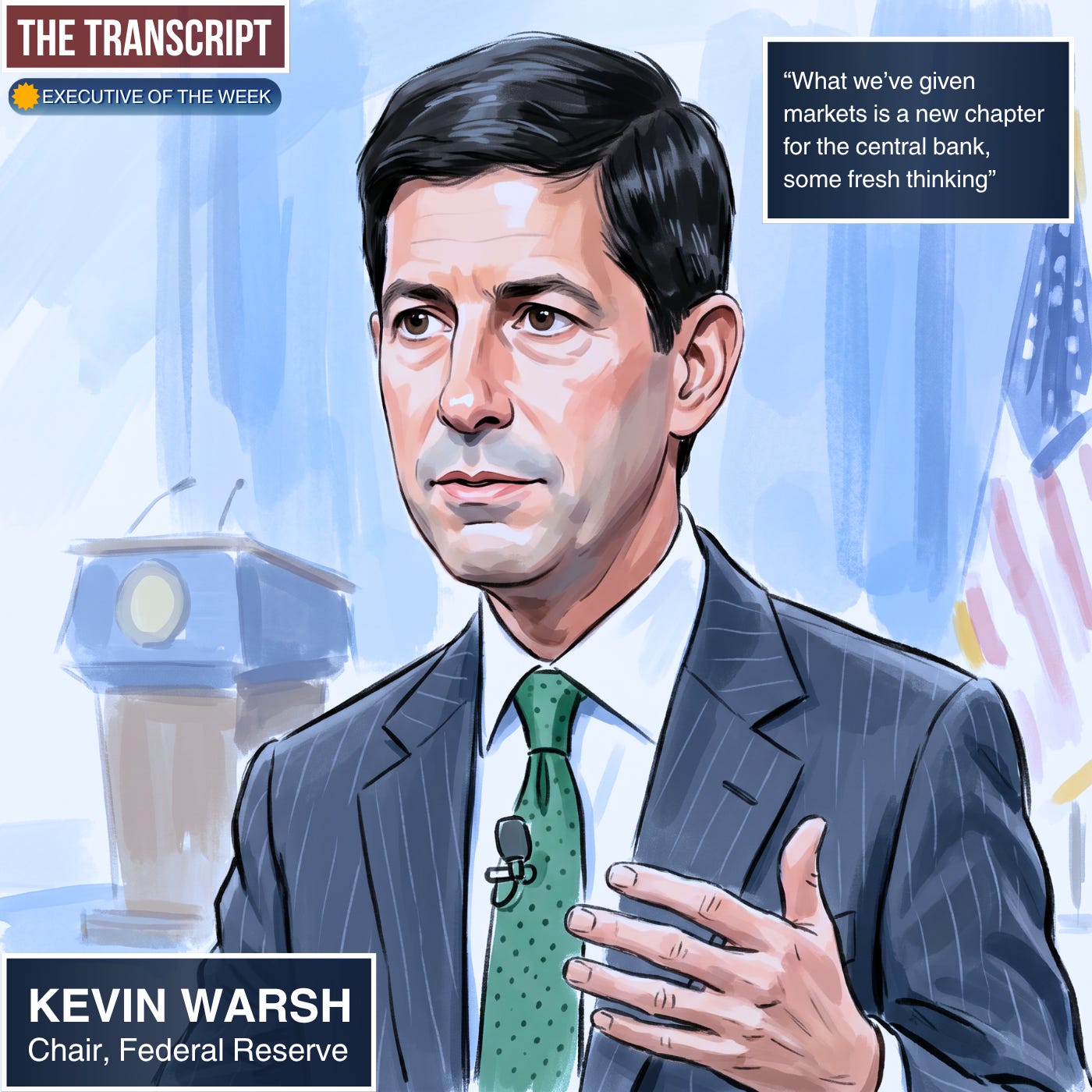
Summary: The Fed met for the first time with Kevin Warsh as chair last week. He seems focused on changing the communication style of the institution.
Editor’s Note: We have made this week’s newsletter available to all subscribers. If you’re not a premium subscriber already, please consider subscribing.
Macro
Consumer spending continues to be strong
“Overall, the consumer, I would say, is relatively healthy. Customer spending with us continues to be strong. You mentioned U.S. comp sales and your opening of 4.1%. If you exclude maximum fair pricing, that would have been at 5.1%, and that’s an acceleration from our prior 4 quarters.” - Walmart (WMT 0.00%↑) U.S. CEO David Guggina
High-income consumers are spending with confidence
“Now I will note that there is variation in spending across household income groups with higher income customers continuing to spend with confidence while our lower income customers are feeling more pressured and making trade-offs, particularly in discretionary categories.” - Walmart (WMT 0.00%↑) U.S. CEO David Guggina
“I would say, mid- to high and sometimes even very affluent. Those are doing pretty well, and we’ve seen very, very healthy consumption patterns in the last few months.” - Global-E Online (GLBE 0.00%↑) CFO Ofer Koren
Lower-income consumers are pressured
“We’ve been pressured, as you mentioned, on the lower income, but we’re seeing some growth in the upper income guests, which has been nice to see. Across the demographics, it’s been pretty consistent.” - Cracker Barrel Old Country Store (CBRL 0.00%↑) CEO Julie Masino
“I’m thinking of a customer who does gaming, entertainment, they’re seeing at the low end, people spending less, less discretionary income at the low end. And it’s not subtle. It’s very noticeable, but that hasn’t sort of resulted in higher delinquencies or anything as we see today.” - M&T Bank (MTB 0.00%↑) CEO René Jones
“The customer is under pressure, higher gas prices and reduced SNAP benefits and squeezing budgets, customers are managing spend carefully and shopping with real intent. That pressure is showing up in the market. Food at home growth decelerated 100 basis points compared to the last quarter.” - Kroger (KR 0.00%↑) CEO Gregory Foran
Sentiment has been weak
“But you are right, the sentiment is getting bleaker even as the facts are quite strong. That’s what we are looking at.” - U.S. Bancorp (USB 0.00%↑) CEO Gunjan Kedia
“We monitor consumer sentiment closely and seeing it low back at kind of 2022 inflationary levels and expect that as sentiment continues to be low and promotional -- competitive promotional spending may level with some of the facing headwinds, expect that there could be additional shifting to private label.” - Oil-Dri Corporation of America (ODC 0.00%↑) VP Consumer Products Division Laura Scheland
The Fed opened a new chapter
“What we’ve given markets is a new chapter for the central bank, some fresh thinking...This is a lot of change for financial markets to digest. I wouldn’t be particularly intrigued by how they react in the first several minutes or even first several days.” - Federal Reserve Chairman Kevin Warsh
Communication will change
“Since last summer, my colleagues discussed possible improvements in the form and function of Fed communications. This new task force will build on that effort and, I expect, propose some well-considered changes, including to the SEP I mentioned a few moments ago.” - Federal Reserve Chairman Kevin Warsh
There will be less forward guidance
“We’ve dropped forward guidance...as a general proposition, forward guidance isn’t the business we should be in.” - Federal Reserve Chairman Kevin Warsh
Warsh doesn’t want to distort markets
“I think financial markets perform best when they react to incoming data. I think the financial markets work less efficiently when they ask a question: How will the Federal Reserve react to that incoming information? The more that markets are paying attention to what’s happening in the real economy, deciding what’s good data and what’s less good data, the more financial markets can price what they believe is the most likely and what the tail risks are. Financial market prices are probably the most important source of information to guide central bankers. But when all the financial markets are doing is reflecting back what we’ve said, then we’re taking the most important source of information, and we’re being blind to it. I’d like us to create a system where those blinders come off, where markets are following data that they efficiently think is reliable, and they’ll be watching data, we’ll be watching data, and they’ll come with better information through market prices to us. We can make more-informed decisions with, ultimately, the goal that I set at the outset: Deliver on the price stability objective that Congress told us to do and that we’ve got to get in the business of doing.” - Federal Reserve Chairman Kevin Warsh
He pledged to deliver on price stability
“I am pleased to report that members of the FOMC are unambiguous and unanimous. This committee will deliver price stability.” - Federal Reserve Chairman Kevin Warsh
Lower oil prices should help
“Obviously, we hope, like everybody else does, that the news coming out of the negotiations between the U.S. and Iran alleviates some of those pressures. But we’re prepared to deal with it regardless of what the outcome is.” - Kroger (KR 0.00%↑) CFO David John Kennerley
“So just to finish, I just looked, oil is tumbling. The ships are roaring out of there. They want to go home, they want to drop. They’re all full with oil. There’s a gusher. I mean, we have 7 or 800 ships are leaving, but if I attack them, none of those ships are leaving. The stock market is way up, way, way up. You know, the stock market is up over the last four or five days when it looks like we’re going to make a deal. Stock market’s up thousands of points. Everybody’s richer. Now, would you rather have that or be like some stupid people?” - U.S President Donald Trump
International
Governments are thinking through AI sovereignty
“Sovereignty has become a keyword because people realize that strategically, if you don’t have a big enough part of a certain ecosystem, in this case AI, you’re going to be exposed to the goodwill of other parties. But I think what’s very important to understand when it comes to sovereignty is: to get sovereignty, you need innovation first. You have to do things in the right order. It’s not enough to say, I want sovereignty. What’s very important is to make sure that innovation can happen in Europe... You will never have the entire ecosystem... but you need at least to have enough skin in the game, in the value in the ecosystem, so that when those discussions or those decisions happen, you have a say.” - ASML Holding (ASM 0.00%↑) CEO Christophe Fouquet
“The situation we’re in collectively right now with Mythos and Fable is something that can happen with overreliance on certain models. Nobody has done anything wrong in the situation. But we will have done something wrong if we just accept this, don’t take the lesson, don’t build out and diversify....you’ll hear me say this over and over again. It is never a good idea to have one option,” - Canadian Prime Minister Mark Carney
China is investing aggressively
“China has been investing also across, uh, the entire ecosystem. I think most really they do very well on the application side, uh, a bit less on what’s before that. But I think they are driving the use of I, uh, most probably more aggressively than any other country.” - ASML Holding (ASML 0.00%↑) CEO Christophe Fouquet
The US is the champion
“I think today the US is a clear winner. They are champion across the entire AI semi ecosystem. I think the one place they were missing a bit out was manufacturing. And I think they have been extremely aggressive in bringing some key company to manufacture in the US...They can do that because they buy chips. 80% of the advanced chips manufactured worldwide is bought by the United States” - ASML Holding (ASML 0.00%↑) CEO Christophe Fouquet
Financials
Loan demand is broadly recovering
“What’s been the real pleasure this year is core loan demand from not just the AI trade or the data centers trade or NDFI, but broad-based mid-American core growth for all the right reasons.” - U.S. Bancorp (USB 0.00%↑) CEO Gunjan Kedia
Credit spreads are really low
“So today, it’s not a big problem, but we have been running credit spreads at really, really low levels for a fairly long time. That could be a good thing or it could be a bad thing. You’re tighter, so you’re priced for perfection in some ways.” - M&T Bank (MTB 0.00%↑) CEO René Jones
Consumer
Walmart has seen good traffic growth
“We delivered our best traffic growth in 6 quarters, and we continue to gain share across a broad base of categories, including general merchandise, which reached its highest share gains that we’ve seen in 5 years” - Walmart (WMT 0.00%↑) U.S. CEO David Guggina
Travel demand remains strong
“Demand for our product remains strong, supported by continued investments in our fleet, onboard experience, and digital capabilities” - American Airlines Group (AAL 0.00%↑) CEO Robert Isom
50% of television consumption is now streaming
“Streaming continues to gain share in total viewing and consumer wallet. Nearly 50% of all U.S. television consumption now takes place within the streaming ecosystem, roughly double the level in 2020.” - Roku (ROKU 0.00%↑) CEO Lachlan Murdoch
Do we need tailored LLMs?
“Students, teachers, parents, and institutions don’t want to park a child in front of a generic LLM and hope for a good outcome. They know that AI is only as good as its data and its training.” - McGraw Hill (MH 0.00%↑) CEO Philip Moyer
Technology
The bull market for AI will last until growth slows
“Everybody is just building and buying and building and buying because if they say they don’t need it, they’ll sell it to someone else. It’s very bull market is that part...rate of change matters a lot. And so if you have any slowdown, once these companies are public, if there’s any slowdown and it’s growing at 100% a year and it grows at 80% a year, the market -- the stock goes down 50%. So you’ll have that moment. I don’t know when that moment is going to happen. It’s going to happen in the next 2 years at some point where people say, wait a second, the growth isn’t as much, or the ROI isn’t as much, and maybe it just benefits the consumer. I don’t know. I don’t know where it lands.” - Apollo Global Management (APO 0.00%↑) Co-President John Zito
Right now, it doesn’t look like anything will slow it down
“Right now, there’s a massive buildup in terms of the AI. I think it’s the right thing to do. I don’t see anything to slow it down because the workload is increasing a lot. I think the question mark is how we are supply constrained. We’re supply constrained. So I think anything slow down is the supply constraint.” - Intel (INTC 0.00%↑) CEO Lip Bu Tan
“Worldwide, the demand for AI infrastructure is still enormous. And the demand for AGI-age computers starts to come up. So the demand is continuing to go up. I think a lot of us are convinced that we’re going to be looking at a supply-limited market for AI, for semiconductor for quite a few years, because the build-up of the infrastructure is huge.” - ASML Holding (ASML 0.00%↑) CEO Christophe Fouquet
The top 2 AI labs need $1 Trillion in chips
“But like just you take the 2 labs, they need $1 trillion in chips. I mean you see the OpenAI announcement last night with NVIDIA, NVIDIA is trying to -- I mean the scale of that Ohio project that got rumored last night is $500 billion. I mean, it’s very [ Masa ] announcement. But the scale, if you just look at the basic assumptions in the 5-year plans of these businesses, $1 trillion is just for chips.” - Apollo Global Management (APO 0.00%↑) Co-President John Zito
There are questions about whether the spend is efficient
“We are in the era of big models. I call this peak inefficiency in AI. I don’t think in the history of computing I’ve ever seen that we need to literally use the United States GDP to train an algorithm. It’s not a good business model right now, I would tell you.” - McGraw Hill (MH 0.00%↑) CEO Philip Moyer
But token prices are collapsing
“I think token maxing and token talk is for -- it’s a lot of BS, honestly. Like, if you look at per unit of knowledge and cost per unit of knowledge, prices are collapsing. Prices are collapsing per unit of IQ, if you did it that way. And so you have to bifurcate different types of compute into inference compute, which is most of us, like my IQ is not high enough to be able to use what Mythos 2 will be powerful enough.” - Apollo Global Management (APO 0.00%↑) Co-President John Zito
Bot traffic has now exceeded human traffic online
“I mean the other thing which I think some version of this has to happen in the future, which is like as these agents are exploding in volume and to give you some sense, I thought that -- I mean, from everything we saw, we thought that the end of 2027 bot traffic, agents and everything else would exceed human traffic. We updated that about 3 months ago, bringing it in saying in the first half of 2027, it was going to exceed it. It’s been exploding at such a rate just a few months ago, we actually pulled it hit again and it turns out bots have already exceeded human traffic online and it’s growing exponentially.” - Cloudflare (NET 0.00%↑) CEO Matthew Prince
CPUs are the next bottleneck
“In the world, there are 1 billion knowledge workers. And realistically, we’re not running one agent per person. They can run very efficiently in parallel. We could run two of them. They can run when we’re a sleep, when we’re at dinner. Now if you do the math, you need 1 billion server CPUs. That’s 20x current global production.. If you think about the phases of AI adoption, each of them has been defined by a different bottleneck. The training era needed consistent GPU resources for training for inference, you needed flexible GPU resources to be able to adjust to unpredictable traffic. The first phase of agents, the bottleneck was models getting smart enough. And the next bottleneck is going to be on access to the CPU resources. And the cloud that got us where we are today, it simply doesn’t get us to where agents need to go.” - Cloudflare (NET 0.00%↑) Product Lead Rita Kozlov
There’s increasing concern about cybersecurity
“You have to put budget in to secure it as well, but we’re also getting the incremental spend in cyber as well because the company overall understands the importance of this and be able to deliver on a secure AI environment...almost every CIO have talked to a CISO, they said, we’ve got a task force. We are reporting the Board every week or every 2 weeks on the progress they make.” - Zscaler (ZS 0.00%↑) Deputy CISO Jason Kohler
“We do need to have them put pedal to the metal. And Mythos, thank God it was Anthropic. When the head of the NSA and Cyber Command came and said, ‘This tool broke into almost all of our classified systems, not in weeks, but in hours,’ and one of the things I don’t know how we do, and I know there’s a big debate in the administration, but we’re not going to get this fixed if we have a less ethical CEO in terms of simply voluntary pretesting. Now, how do we get to the right incentives? And it doesn’t have to be 90 days—it could be 30 days” - U.S Senator for Virginia Mike Warner
Vulnerabilities will eventually be fixed
“So I think for the next 2 years, every security company is going to be wildly busy. We’re going to have a sort of Log4J like vulnerability, which was probably one of the worst kind of vulnerabilities that was out there...But I think that what’s going to change is that going forward, software is going to get a lot more secure. I think there’s going to be a flip probably about 2 years from now, where all of a sudden, it’s sort of like, huh, it’s gotten much harder to find where those bugs are.” - Cloudflare (NET 0.00%↑) CEO Matthew Prince
Healthcare
A billion people could be on GLP-1s
“We’re in a very privileged position right now to have been a part of the earliest innings of this vibrant and growing obesity category. But the reality is, despite the fact that we have millions of people on these medicines in the United States, maybe tens of millions more outside the United States, there are plausibly a billion that could benefit from these medicines. So we’re like in the infancy of this space.” - Eli Lilly (LLY 0.00%↑) Executive VP Kenneth Custer
Oral GLP-1s should expand the market
“But in the United States, you can clearly see that, I don’t know, 3/4 or so of patients starting on the oral GLP-1s seem to be new to the incretin category. That’s actually exciting in my mind because it validates our hypothesis that there were a lot of people waiting for something like this, and that seems to be playing out.” - Eli Lilly (LLY 0.00%↑) Executive VP Kenneth Custer
Industrials and Transport
Industrial demand has made good progress
“We see momentum continue to build. We saw good progress in Q1 in about 60% of the portfolio, that’s general industrial or safety, which was up mid-single digits, which is very encouraging. We see trends in that area continuing into Q2. We saw 5 months of solid PMI. PMI in May was actually pretty good at 54%. So it’s actually encouraging the macro trends” - 3M (MMM 0.00%↑) CEO William Brown
There’s a shortage of engineers
“Our application consumption should increase substantially with AI and -- the thing about infrastructure engineers is there is severe resource constraints on their capacity, and they can’t do any more work. It’s very important to make them more productive. And for instance, just saving them the tedium of drawing production will enable them to do 20% more projects that tackle the backlog and allow their firms to bid on more work, finally.” - Bentley Systems (BSY 0.00%↑) President Gregory Bentley
Materials & Energy
Oil markets could shift to oversupply in 2027
“Our first look at 2027 balances shows a significant overhang emerging next year. Global oil demand is projected to rise by a relatively modest 2 mb/d to 105.3 mb/d. By contrast, oil supplies look set to surge by around 8 mb/d to 110 mb/d. This may provide a welcome respite to the market and an opportunity to replenish depleted inventories, or to build new strategic reserves, as countries review their energy strategies and policies in response to the crisis.” - International Energy Agency
Aluminum markets are tight
“Inventories at record low levels globally, even though there seems to be some supply in China, that’s not making its way out because of export tariffs and taxes there that are disincenting that. So yes, we are in a tight market. As we’re talking to our customers in North America, they’re really trying to secure supply for the rest of the year, and some of them are even talking into ‘27 because they’re worried about the Middle East supply coming back online.” - Alcoa (AA 0.00%↑) CFO Molly Beerman
Nuggets of Wisdom
Be rigorous on your taxes and engage in philanthropy
“When I got, when you made partner, you had a conversation with a senior partner there who was sort of assigned to acculturate new people to the firm, and he gave you some rules of the road..a warning to make sure you’re very rigorous and conservative on your taxes. And then there were two other things that they advised. One of which is they set up a charitable foundation for you, and they said, ‘We expect you to do this, to use it, and to give money away. It’s good for your personal life, and it’s also good for your professional life to be thought of as somebody who gives back to the community. As a result of being on philanthropic boards and other things, you’ll engage with a set of people that’s broader than the people you might meet in your business life. So it’s good for you, good for the firm...And then the final thing they said was, ‘As far as your balance in your life, think of it this way: if you live the kind of life that there’s an obituary written about you and it’s nine paragraphs long, make it so that no more than three of those nine paragraphs are about your life at Goldman.’” - Goldman Sachs (GS 0.00%↑) Senior Chairman Emeritus Lloyd Blankfein
Anxiety can be a competitive advantage
“I inherited from my dad — he was an anxious person — and I made my kids anxious. Unfortunately, there’s benefits and burdens to every situation. Being anxious and looking around corners for problems and seeing things that could go wrong, I think that suited me in my job... I was in a risky business with a firm with a big balance sheet that had a lot of investments, bought and sold, and priced risk and took on other risks that other people didn’t want to have for a price. If you’re going to do that job and preside over other people doing that job, it helps to be somewhat focused on things that could go wrong. In my life, I’m generally upbeat that I think things will tend to work out, but I know that before they work out, they go wrong. A lot of things go wrong.” - Goldman Sachs (GS 0.00%↑) Senior Chairman Emeritus Lloyd Blankfein
The M&T Bank quote is the most revealing thing in this entire edition and it almost slips past. "Spending less at the low end. It's very noticeable, but that hasn't resulted in higher delinquencies." Think about why. The people cutting back are doing it precisely to avoid the delinquency. They're shrinking their lives, buying less food, skipping meals out, cancelling subscriptions, doing whatever it takes to keep the minimum payment current. The discipline is what's hiding the stress.
So the credit data says everything is fine because delinquencies haven't spiked. But the spending data says people are managing through genuine pain by contracting before they default. The absence of delinquency isn't health. It's the sound of millions of households quietly reorganising their lives around a tighter budget to avoid a late payment at 22% APR. When the discipline breaks, the delinquency spike won't be gradual. It'll arrive all at once, because everyone was holding on at the same time.