
Catalyst Watch
Tokenomics

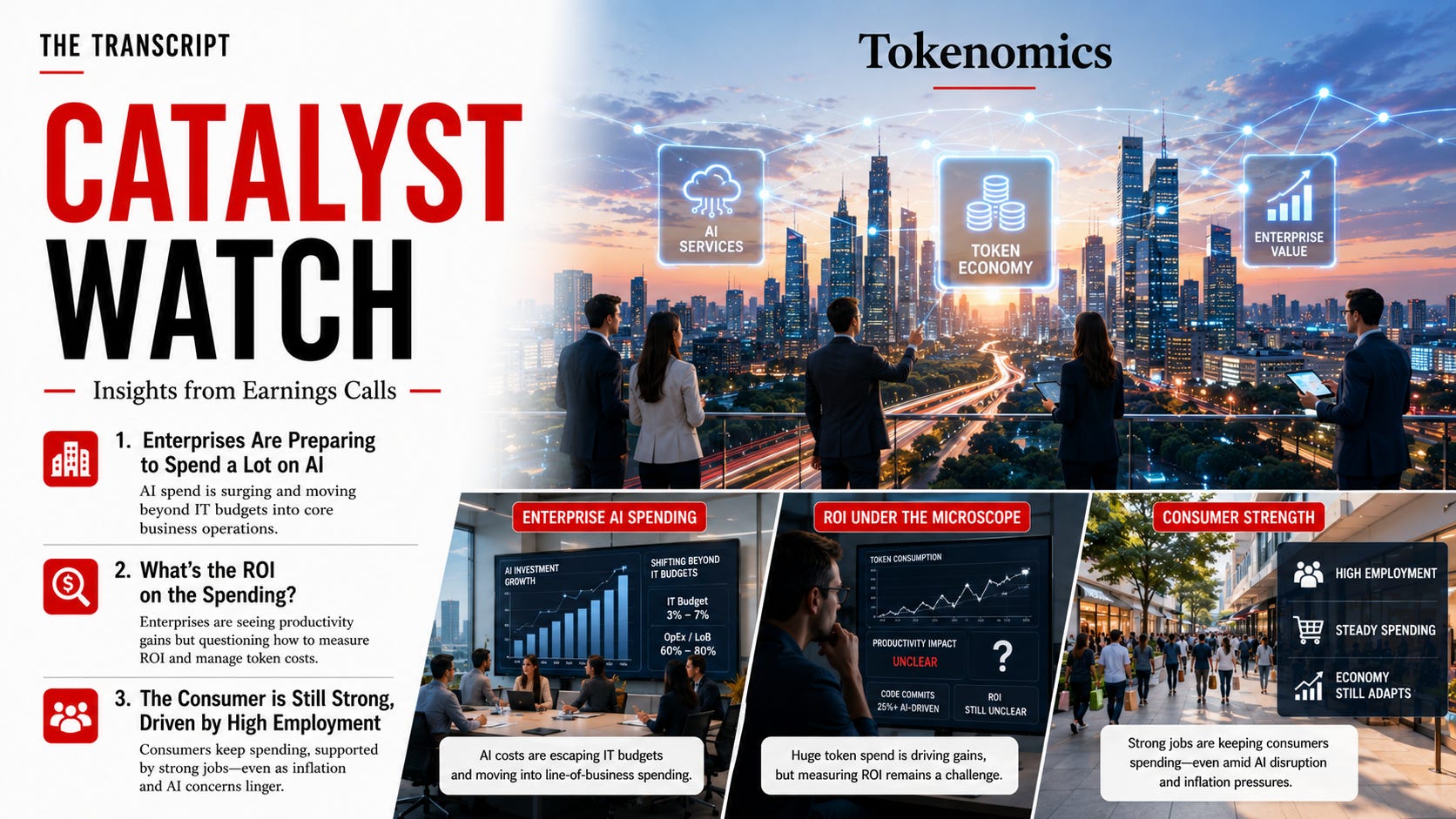
Welcome to Catalyst Watch at The Transcript, a report that highlights investment themes from this week’s newsletter. This week’s edition is available for all subscribers.
1. Enterprises Are Preparing to Spend a Lot on AI
Over the last few weeks, it’s become clear that companies are starting to spend serious amounts of money on AI services. The spend is becoming so large that, according to Box’s CEO, it will start to eclipse IT budgets and eat into Opex budgets:
“One of the nuance sort of shifts that’s going to happen is I think the first two to three years of AI, the IT budget could kind of consume the AI costs...as you know, IT spend is basically somewhere between like 3% to 7% of corporate revenue in a company...so then the question is, well, where’s the other 60%, 70%, 80% of revenue in an organization? It’s opex and just general-purpose opex across the business. And so if AI is truly adding this productivity gain to your engineering team, or your client onboarding process, or your marketing team, then clearly you don’t want to be trapped by this sort of 3% to 7% in the business. It’s going to escape that and move to the line-of-business budgets.” - Box (BOX 0.00%↑) CEO Aaron Levie
The big research labs are the primary beneficiaries of this spending.
2. What’s the ROI on the Spending?
In our April 21 issue of Catalyst Watch, we highlighted a quote from Uber’s CTO talking about how the company was blowing through its budget spending on AI.
“I’m back to the drawing board, because the budget I thought I would need is blown away already.” – Uber (UBER 0.00%↑) CTO Praveen Neppalli Naga
So it was interesting this week to see Uber’s COO lightly questioning the ROI on that spend. Here’s what he had to say:
“Our CTO, Praveen, went viral because he effectively said in an interview that we had blown through our AI budget for 2026, and it was like the middle of March or something when he said this. Everyone was like, “Head exploding moment. We’re going to have to start talking about token consumption and the associated cost versus headcount, and making trades on that as an engineering organization.”...I mean, the headline stats make your head explode, right? When you hear companies talking about, hey, 25% of code commits over the last quarter were AI-driven.It’s amazing, and I think it’s this massive transformation of society. But then you sometimes go and talk to your senior engineering leaders…it’s very hard to draw a line between one of those stats and, okay, now we’re actually producing like 25% more useful consumer features, right? And that line is hard to draw. I think over the coming quarters and years, maybe that will become clearer, but I think today it’s hard, even if some of the underlying metrics are trending in a really astronomical direction.” - Uber (UBER 0.00%↑) COO Andrew Macdonald
The actual quote isn’t a full-throated rebuke of ROI on AI spend; it’s more of a running question. Box’s CEO perhaps captured the mood with a bit more subtlety when he called it an “uncomfortable acceptance” of the spend rather than an “I’m not doing this anymore” surprise.
“Enterprises are saying okay, I’m quite surprised by these bills, and it’s like an uncomfortable acceptance surprise as opposed to like I’m not doing this anymore surprise because they’re empirically getting the productivity gains or they just wouldn’t be paying the bills.” - Box (BOX 0.00%↑) CEO Aaron Levie
As he says, companies must be getting enough productivity gains from the AI spend, or they wouldn’t be paying for it.
Still, companies are going to have to do a better job going forward of managing token spending. Brian Moynihan at Bank of America captured this at a conference:
“The amount of money we spend on this can’t be infinite because it’s got to have value. And so we test every project. We have 22 colleagues led by Jeff Busconi working on this. We went up to 3,000-plus people, give us your ideas. We’re trying to make this everybody’s work in our company. So, we'll see it play out, but it's going to have a big impact.” - Bank of America (BAC 0.00%↑) CEO Brian Moynihan
Will this ultimately impact revenue growth at the research labs, or will AI spend continue to surge? Probably yes to both questions.
3. The Consumer is Still Strong, Driven by High Employment
AI is increasingly the central focus of capital markets, but the underlying consumer economy remains fairly strong in spite of higher oil prices. While there’s a lot of pressure from inflation, at the end of the day, employment is high, and that is keeping spending flowing.
“people are spending money, and that’s because, frankly, they’re employed...The customers have got to -- the consumer lives their life and does their things. And they’re not -- the real impact on -- if you look across the 30 years of this data, is when unemployment starts moving. And so if you watch new claims or something like that, and they start moving against, they’re very low 200s, some thousand, they haven’t moved much. continuing claims, 1.7 or something haven’t moved much.” - Bank of America (BAC 0.00%↑) CEO Brian Moynihan
There are valid concerns that AI could impact this, though. Although no one really knows what the long-term impact will be, Goldman Sachs’ CEO tried to remind us this week that the historical effect of technology on jobs has been positive:
“The historical pattern is clear: The U.S. economy can and will adapt to major advances in technology. What’s also clear is that stark forecasts by even the most brilliant minds often miss their mark. In 1930, John Maynard Keynes famously predicted that, by 2030, people would work only 15 hours a week. While his vision of a leisure-filled future remains unfulfilled, it is a good reminder that fears of a job apocalypse may very well overlook A.I.’s potential to spur an economic and productivity revival.” - Goldman Sachs (GS 3.22%↑) CEO David Solomon