
Catalyst Watch
Not Your Grandma’s Economy

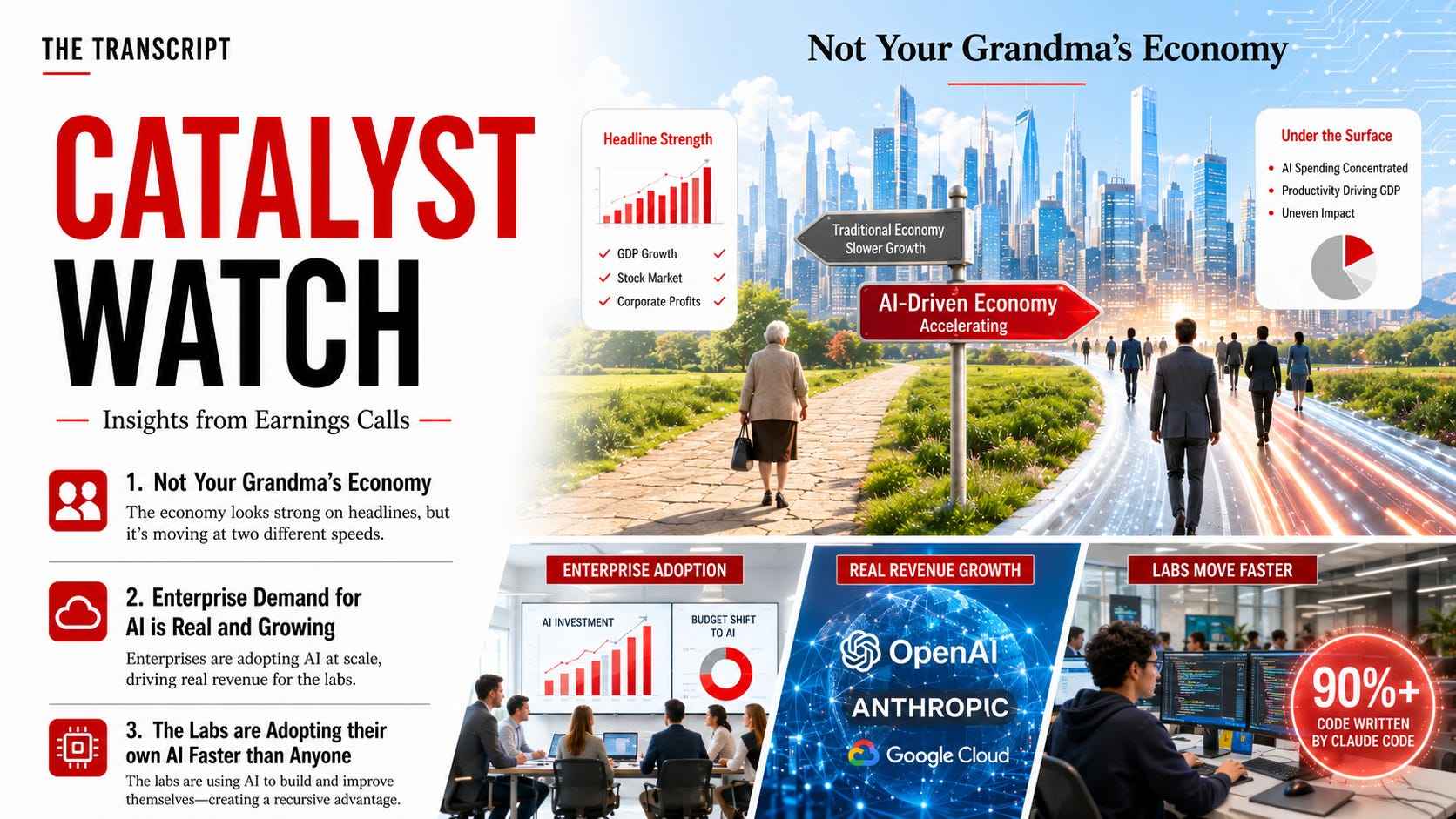
Welcome to Catalyst Watch at The Transcript, a report that highlights investment themes from this week’s newsletter. This week’s edition is available for all subscribers.
1. Not Your Grandma’s Economy
Starwood Property Trust is a $6B market cap REIT and doesn’t own datacenters, but its CEO captured an increasingly prevalent sentiment within the economy this week when he said this:
“And I tend to think the GDP numbers are sort of the illusory. You can talk about them as being great, and they are what they are, but they’re really driven by 2 things: AI spending, which isn’t felt by the average American, and by productivity gains. And that kind of GDP is not the kind of GDP that normally would send those consumers to the store. And as you know, consumption is 70% of GDP. So it is a miraculous economy, but it’s not your grandma’s economy, and it’s creating all kinds of odd things and investors chasing multiples of revenues in the equity markets.” - Starwood Property Trust (STWD 0.41%↑) CEO Barry Sternlicht
On a headline basis, the economy and certainly the stock market are very strong, but the underlying structure of the economy feels like it’s changing rapidly. As with most economic change, shifts create winners and losers.
The clear winners today are the companies that have exposure to AI. While everyone else isn’t clearly losing ground, it does feel like the economy is moving at two different speeds.
Ken Griffin at Citadel captured some of the melancholy that many people in the economy are feeling around this change:
“In the last few months, there has been a step change function in the productivity of the AI toolkit. It is profoundly more powerful than it was just nine months ago. And for us at Citadel, that has allowed us to unleash a much broader array of use cases for AI. And it has been really interesting to watch. To be blunt, work that we would usually do with people with master’s and PhDs in finance over the course of weeks or months is being done by AI agents over the course of hours or days. So these are not mid-tier white-collar jobs. These are like extraordinarily high-skilled jobs being I’m going to pick a word, being automated by agentic AI. And I got to tell you, I went home one Friday. actually fairly depressed by this because you could just see how this was going to have such a dramatic impact on society. And when you witness it in your own four walls, when you see work that used to be man-years of work being done in days or weeks. It’s like, wow, like that’s the first time I’ve seen real impact in our four walls.” - Citadel CEO Ken Griffin
2. Enterprise Demand for AI is Real and Growing
6-12 months ago, there were many questions about whether enterprises would find real use cases for AI. Judging by comments about spending, it appears that enterprises are definitely adopting AI at scale.
We published quotes from Expedia, Shopify, and Airbnb this week, all of which discussed the growing cost of deploying AI and how they are managing budgets to prioritize AI tools.
“Definitely, we’re seeing the use of AI and the associated costs, broadly speaking, increasing...I expect token costs to go up... but I think the teams have done a good job continuing to take costs out. It’s kind of a mix of productivity to pay for additional investments in AI.” - Expedia Group (EXPE -0.26%↓) CFO Scott Schenkel
The AI labs are the beneficiaries of this spend. This was captured in a quote from Softbank, which mentioned that 50% of OpenAI’s revenue will be enterprise by the end of the year.
“But actually, OpenAI has also been putting an effort into enterprise business, and they are accelerating this business as well. Right now, it’s about 40% enterprise share of the total revenue. And that is expected to be 50% by the end of 2026. So as a result, consumer business and enterprise business will be about the same size. That’s how we see around the end of this year.”- SoftBank Group (SFTB:CA) CFO Yoshimitsu Goto
Obviously, strong enterprise demand supports hyperscalers’ data center spending. The spending is clearly not completely speculative. There is firm demand underlying it, and the capex is also being funded heavily by the operating cash flow. This is much different from the dot-com era. Cisco captured this on its earnings call:
“I think the customers that are consuming all this technology are highly profitable, high cash flow, and they view this technology as existential to their business.“ - Cisco (CSCO -0.97%↓) CEO Chuck Robbins
3. The Labs are Adopting their own AI Faster than Anyone
In recent quarters, many companies have been quoting what percent of their code is being written by AI. For most companies, this has ranged between 50-70%. Shopify, for instance, mentioned that “AI now writes well over 50% of our code, and that number is going up.”
It stood out, though, that for Anthropic, that number is already at 90%:
“But right now, within the company, 90-plus percent of our code is actually written by Claude Code. A lot of Claude Code’s code is written by Claude Code.” - Anthropic CFO Krishna Rao
This seems important because it’s a sign that even within the tech sector, a multi-speed economy may be emerging. “Old tech” companies like Shopify, Expedia, and Airbnb already employ armies of software engineers and are adopting AI tools in order to boost their productivity. But the research labs are creating new forms of productivity.
The key in the quote above is that Claude is writing large percentages of its own code. We’ve highlighted this recursive self-improvement in the past and published quotes from Anthropic talking about how even researchers are starting to fall out of the loop in improving the fundamental models.
Ultimately, this could create a dynamic where the research labs’ systems improve at a much faster rate than old tech’s engineers can keep up. Anthropic isn’t just creating cutting-edge tools; they are using them to improve their own products, and those products may increasingly compete with old tech.
Does no one else see the irony that most of the benefits of AI is in coding meaning the coders have coded their way out of work?