
There Will be Pricing Pressure
In the near term, higher energy prices will push up overall inflation, but it is too soon to know the scope and duration of the potential effects on the economy

Succinct Summary of Each Section:
Macro: War with Iran doesn’t seem to be impacting the economy, but pressures are starting to build. The Fed is keeping interest rates on hold, and Jerome Powell could stick around for longer than expected.
International: Chinese consumers may be rebounding.
Financials: Capital markets have remained resilient despite the conflict.
Consumer: The economy continues to show K-shaped dynamics. Higher gas prices won’t provide relief.
Technology: Micron reported eye-popping growth. AI is supply-constrained. There’s a good argument as to why inference could potentially move towards the edge.
Healthcare: Research institutions are funding-constrained.
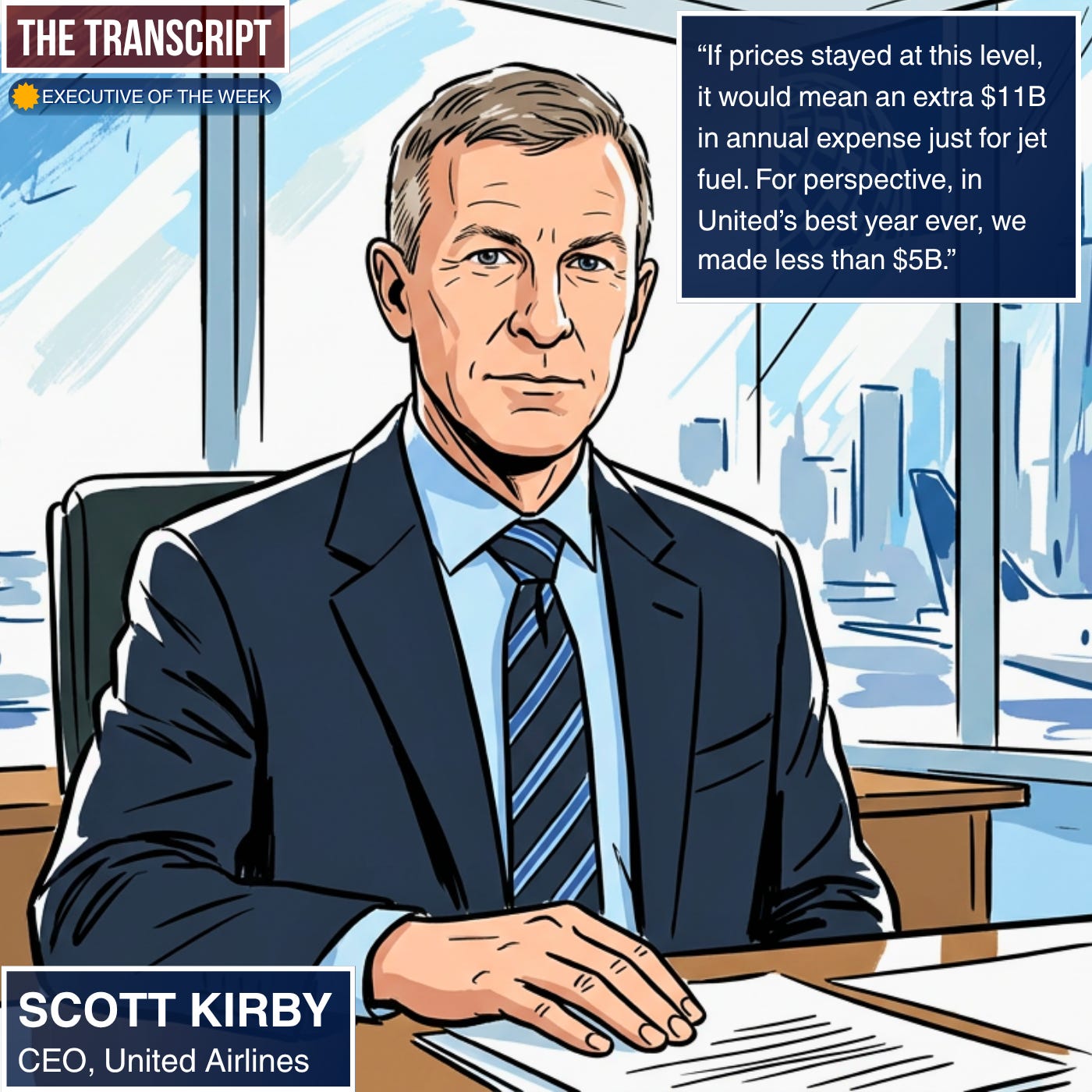
Industrials: Long discussion about the impact of oil prices on airline profitability, including insight into how consumers are currently reacting to higher prices.
Energy: Additional discussion about the impact of the closure of the Strait of Hormuz and why insurance (not Iran’s military) may be the main reason that ships aren’t passing through the Strait.
Catalyst Watch: Keep an eye out tomorrow for a new edition. Here’s a link to last week’s post for non-paid subs.
Editor’s Note: We have reserved the sections after Macro for our premium subscribers. If you’re not a premium subscriber already, please consider subscribing.
Macro
War with Iran doesn’t seem to be impacting the US economy for now
“Some of the economic impact there, especially as it relates to the U.S. economy, is sort of -- it’s not hitting yet, and so it’s still in front of us.” – Morgan Stanley (MS 0.00%↑) Co-president Daniel Simkowitz
“Through mid-March, our daily revenue indications from audits, endorsements, and cancellations are still in positive territory, indicating continued solid business activity and no signs of a broad slowdown...We’re just not seeing signs of economic weakness” – Arthur J Gallagher (AJG 0.00%↑) Chairman & CEO Patrick Gallagher Jr.
Capital markets have been resilient
“We’ve raised $75 billion in the last 6 weeks with hyperscaler debt, $50 billion of that just in the month of March after the conflict. And you’re seeing some of the private equity LBO financing starting to move through the market. And just yesterday, we announced a big M&A deal in the real estate storage space. So in essence, the underliers and the receptivity to go do capital are pretty strong.” – Morgan Stanley (MS 0.00%↑) Co-president Daniel Simkowitz
Higher oil prices could mean higher inflation and weaker consumption
“...if we have a long period of much higher gas prices, that’s gonna weigh on consumption. Now, it’ll weigh on disposable personal income, and it’ll weigh on consumption. But we don’t know if that’s gonna happen. Something quite different than that. We might have much lower than expected pass-through.” – Federal Reserve Chair Jerome Powell
“The new Gulf War threatens to disrupt all those benign trends. If the elevated oil price stays 20% to 30% above its pre-conflict level before the conflict broke out, it’s around about $70 a barrel. Now it’s hovering between $95 and 110. That’s likely to put global inflation up by between 0.5 And 1 percentage point and slow global growth by between 0.3 and 0.5 percentage points. That effect of course gets larger the longer the oil supply out of the Gulf remains effectively cut off or severely constrained.” – Aon (AON 0.00%↑) BBC News Economics Correspondent Andrew Verity
They can also cause political pressure
“The pump price is rising, particularly in the United States, and the pressure is immense. When gasoline prices are above US4 a gallon, you’ve got a massive problem in the United States. “You see demand destruction as people stop driving and flying. The US consumer is also the loudest voice in a midterm year.” - Glencore (GLEN) CEO Gary Nagle
“Prices, costs at home for consumers are rising as well. I just checked a few minutes ago, and a month ago, in my home state of Delaware, a gallon of gas was $2.87. Today, it’s $3.68. That’s a 30% jump in just a month. The fastest increase in gas prices since the 1973 oil embargo. Nationally, a similar rise, $2.95 to 3.84. The larger point is most Americans know they’re paying a lot more at the pump. They’re paying more at the pump, and it’s gonna end up having all sorts of secondary consequences for costs because what passes through the Strait of Hormuz isn’t just oil. It’s oil, it’s natural gas, it’s petrochemicals, it’s fertilizers, it’s helium. It’s a whole series of things essential to our modern economy. We are on the verge of planting season. It will soon be spring, and American farmers are seeing their fertilizer prices jump as well.” - United States Senator Chris Coons
It’s not clear how the Fed will react
“The implications of events in the Middle East for the US economy are uncertain. In the near term, higher energy prices will push up overall inflation, but it is too soon to know the scope and duration of the potential effects on the economy....People write down this is one of those SEPs where a number of people mentioned if we were ever gonna skip an SEP, this would be a good one, because we just don’t know.” – Federal Reserve Chair Jerome Powell
Rates may not come down as quickly as hoped
“...there was actually some movement toward -- a meaningful amount of movement toward -- toward fewer cuts by people. So four or five people went from two to one, let’s say. Two cuts to one cut.” – Federal Reserve Chair Jerome Powell
Jerome Powell may stick around longer than expected
“...if my successor is not confirmed by the end of my term as chair, I would serve as chair pro tem until he is confirmed. That is what the law calls for, that’s what we’ve done on several occasions, including involving me, and that’s what we’re going to do in this situation. And while I’m at it, on the question of whether I will leave while the investigation is ongoing. I have no intention of leaving the Board until the investigation is well and truly over, with transparency and finality” – Federal Reserve Chair Jerome Powell
